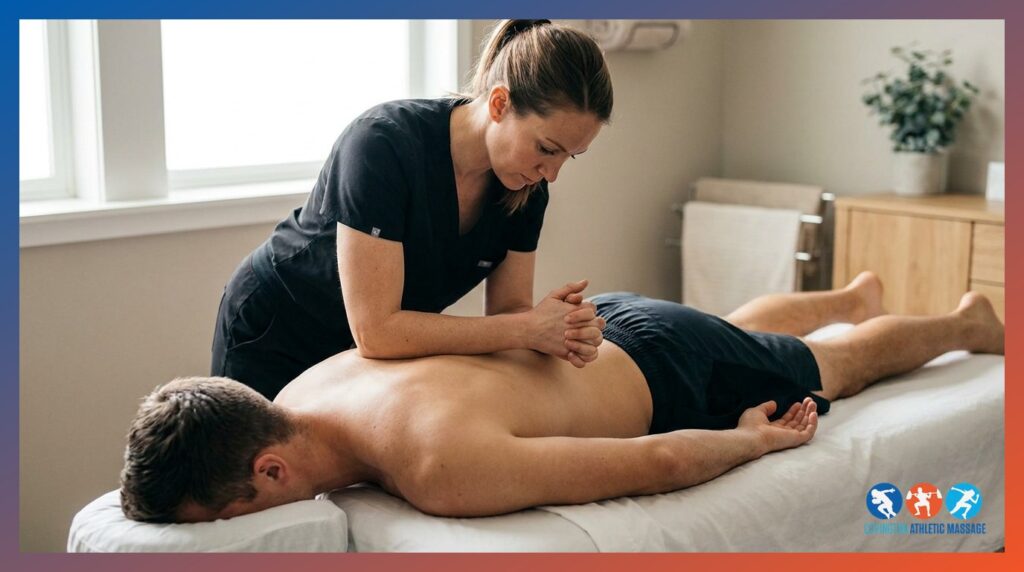
Pain Relief Therapy at Covington Athletic Massage is a targeted deep tissue sports massage session that treats acute and chronic muscular pain in athletes and active adults across Covington, Georgia. Covington Athletic Massage therapists locate and release the specific muscles, trigger points, and adhesions generating each client’s pain. Pain Relief Therapy delivers measurable relief from chronic aches, muscle tightness, and the nagging tension that limits training and daily function.
What is Pain Relief Therapy at Covington Athletic Massage?
Pain Relief Therapy at Covington Athletic Massage is a targeted deep tissue sports massage session that locates and releases the specific muscles, trigger points, and fascial adhesions generating an athlete’s pain. Pain Relief Therapy is not a full-body relaxation massage.
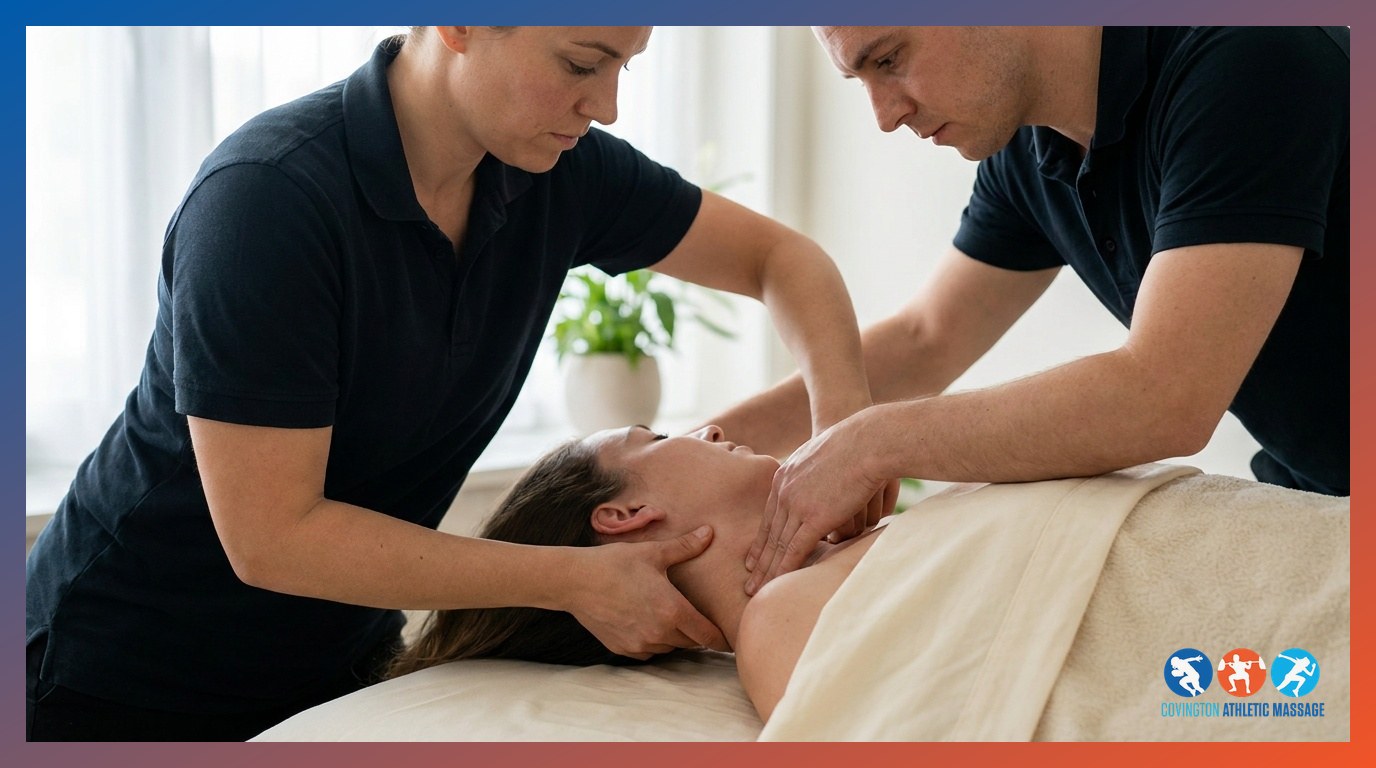
Every Pain Relief Therapy session starts with palpation, not pressure. The therapist presses along the musculature to map where pain actually originates before any technique is applied, because the spot that hurts is not always the tissue at fault. A 2024 publication in Frontiers in Medicine defines a myofascial trigger point as a hypersensitive, palpable area within a taut band of skeletal muscle, and a trained therapist can feel these bands and nodules directly. That mapping step separates Pain Relief Therapy from generic pressure application.
A Pain Relief Therapy session then treats specific painful muscle groups with four core techniques:
- Trigger point release: direct, sustained pressure on a palpable nodule until the taut band lets go.
- Myofascial release: slow, sustained pressure into fascial adhesions to restore glide between tissue layers.
- Cross-fiber friction: deep strokes applied across the muscle fibers to break up adhesions.
- Sustained deep tissue pressure: prolonged compression along hypertonic muscle bands that hold chronic tension.
Trigger points and muscular knots form when repetitive athletic loading, overuse, poor recovery, and sustained postural tension keep muscle fibers contracted past their ability to reset. Runners, lifters, and weekend competitors around Covington accumulate that load faster than rest alone can clear. A knot built over weeks of training does not release because an athlete sleeps well for two nights; the tissue needs direct mechanical input.
Pain Relief Therapy is not a general relaxation massage or a recovery massage. The intent is diagnostic and corrective: the therapist actively locates the specific tissue generating pain, whether a trigger point, a fascial adhesion, or a hypertonic band, rather than applying broad-stroke pressure over the whole body. Athletes who have tried regular massage without lasting relief often had their symptoms masked rather than addressed at the source. Broad pressure relaxes everything for a day or two; targeted release changes the tissue that started the problem.
Pain Relief Therapy is a hands-on, non-pharmacological intervention, meaning the work acts directly on the physical tissue causing pain with no medication involved. The evidence supports that approach. According to a 2024 JAMA Network Open analysis of 129 massage therapy systematic reviews, seven conclusions reached moderate-certainty evidence; all seven found massage therapy beneficially associated with pain across conditions including chronic low back pain, fibromyalgia, and myofascial pain, and adverse events were rare. The sports massage Covington GA covers how Pain Relief Therapy fits alongside the clinic’s recovery and performance sessions.
Who is Pain Relief Therapy for?
Pain Relief Therapy applies to athletes and active adults in Covington, Georgia who experience chronic muscle tension, tight muscles, nagging aches, or localized knots that rest alone has not resolved. Pain Relief Therapy serves people whose pain is muscular in origin and recurring in pattern.
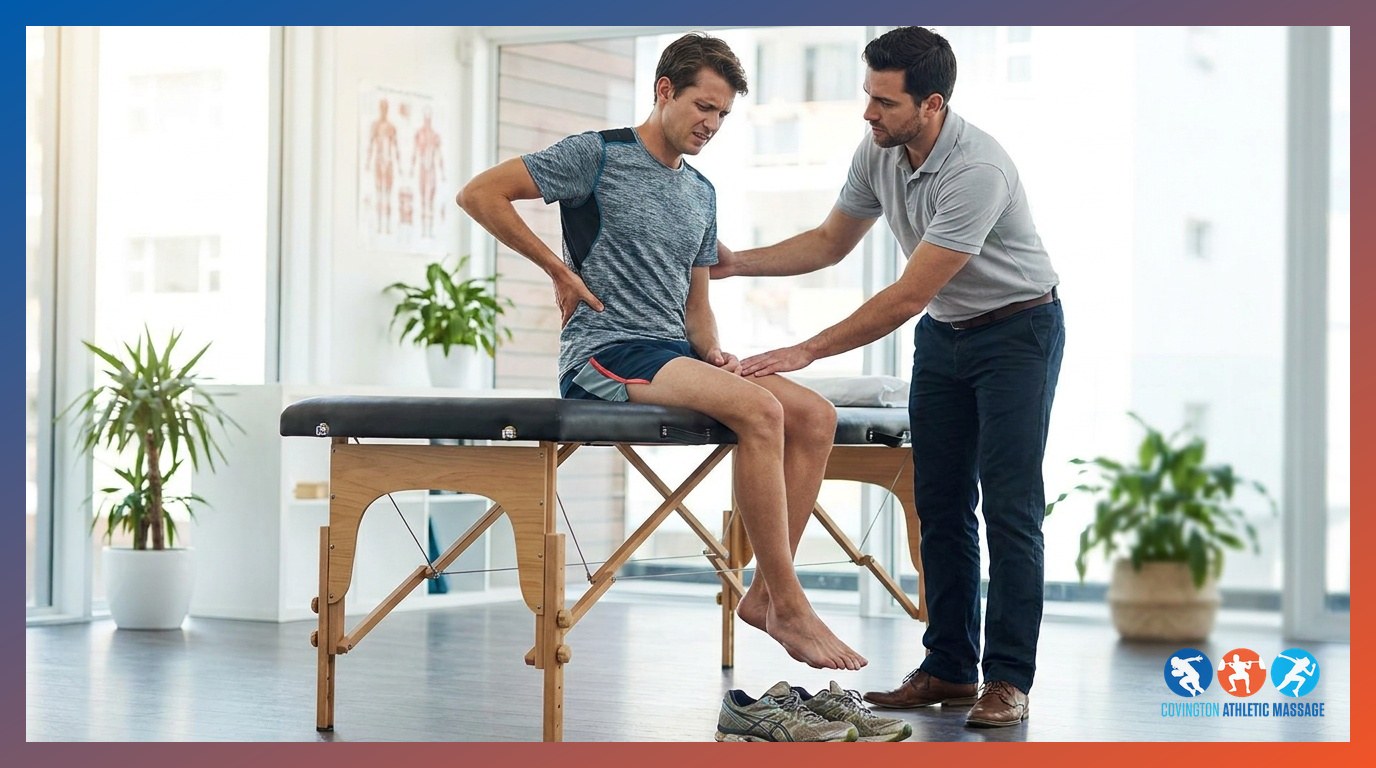
Pain Relief Therapy is used by runners, cyclists, overhead athletes, and desk-working athletes with persistent pain patterns. Runners commonly present with hip and low back pain, and low back pain is widespread: the World Health Organization reported in 2023 that roughly 619 million people live with it globally. Cyclists carry tension through the thoracic spine and neck, while desk-working athletes hold it in the upper back and cervical region. Overhead athletes develop shoulder tightness, and a 2022 PMC review notes that repetitive overhead movement in sports like baseball, tennis, volleyball, and swimming overloads shoulder muscles and fosters trigger points in the upper trapezius.
Normal soreness is different. Delayed onset muscle soreness, the ache that peaks a day or two after hard training, fades with rest and light recovery massage. Pain Relief Therapy applies when soreness stops fading and becomes a fixed, recurring pattern. Athletes who train through that kind of pain build compensatory movement patterns that raise injury risk over time, and a targeted session interrupts that cycle before compensation becomes structural damage. Many of these athletes also prefer drug-free relief, and the medication-free pain management athletes resource explains how manual therapy manages muscular pain without pharmaceuticals.
Pain Relief Therapy treats muscle-generated pain in structurally intact tissue. Strains, tears, and tendinitis belong to Injury Care Massage, and the massage therapy for injuries resource explains how that treatment addresses structural soft-tissue damage. The contrast matters. An athlete with a knotted calf needs Pain Relief Therapy; an athlete with a torn hamstring needs Injury Care, and conflating the two produces the wrong treatment.
Pain Relief Therapy is not appropriate during an acute inflammatory phase or for undiagnosed referred pain. Pain radiating down an arm or leg can indicate nerve involvement, so athletes with radicular symptoms should obtain medical clearance before booking.
What does a Pain Relief Therapy session involve?
A Pain Relief Therapy session contains an intake assessment, targeted palpation to locate pain sources, deep tissue and trigger point work, and a post-session care recommendation. The therapist directs each stage toward the athlete’s specific pain pattern rather than general relaxation.
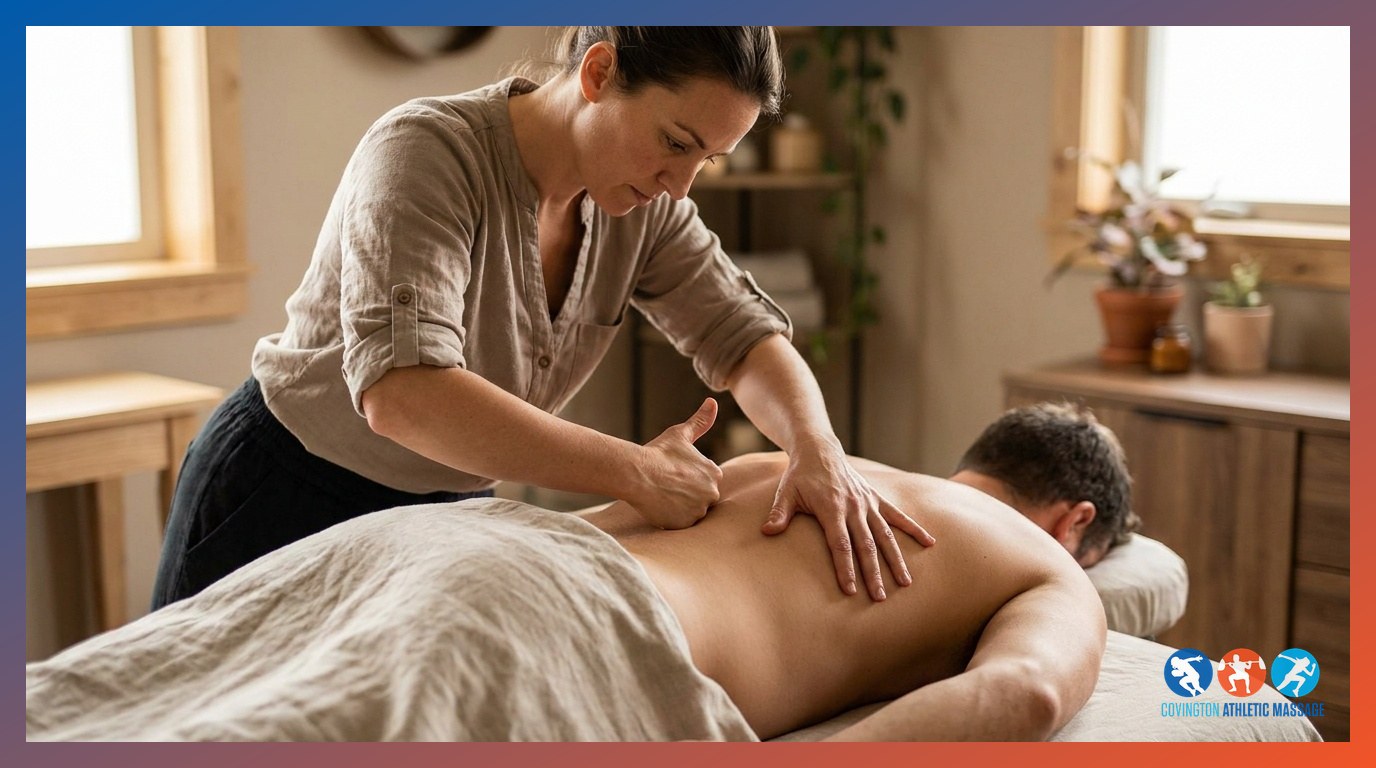
The session opens with a brief intake. The therapist asks where the pain sits, when it started, what the current training load looks like, and which treatments the athlete has already tried. Those answers set the focus area before any hands-on work begins.
Next comes palpation. The therapist systematically assesses the target muscle groups to locate trigger points, adhesions, and areas of hypertonicity. Trigger point identification follows clinical criteria such as a palpable taut band and reproduced referred pain on compression, and the Journal of Orthopaedic & Sports Physical Therapy reports good interexaminer reliability for these criteria (κ = 0.84–0.88).
The treatment phase applies sustained trigger point release, deep tissue stripping, and myofascial work to the identified pain sources. Pressure stays intentional and can feel intense, but the therapist keeps the pressure within a tolerable range and adjusts to the athlete’s feedback.
The session closes with care recommendations: hydration, light movement, and an expected soreness window of 24 to 48 hours. That soreness reflects the tissue’s response to deep release work, not a worsening of the original complaint.
Pain relief from a single session is real but partial for chronic patterns. A 2025 meta-analysis in the IGI Insight Journal found massage therapy significantly reduced pain versus control groups (SMD = −0.87), yet athletes carrying multi-month tension accumulation typically need 2 to 4 sessions before the tissue stops reverting. Covington Athletic Massage states this timeline during the intake, which separates the clinic from providers who promise instant resolution from one visit. The whole-body massage recovery session covers full-body maintenance techniques for athletes whose goal is general recovery rather than focused pain work.
Which pain areas does Pain Relief Therapy address?
Pain Relief Therapy addresses five primary pain zones: neck pain, tension headaches, tight shoulders and upper back, low back pain, and hip pain. Covington Athletic Massage pairs each zone with a dedicated condition-specific session, so an athlete with a known pain focus can book the matching variant directly.
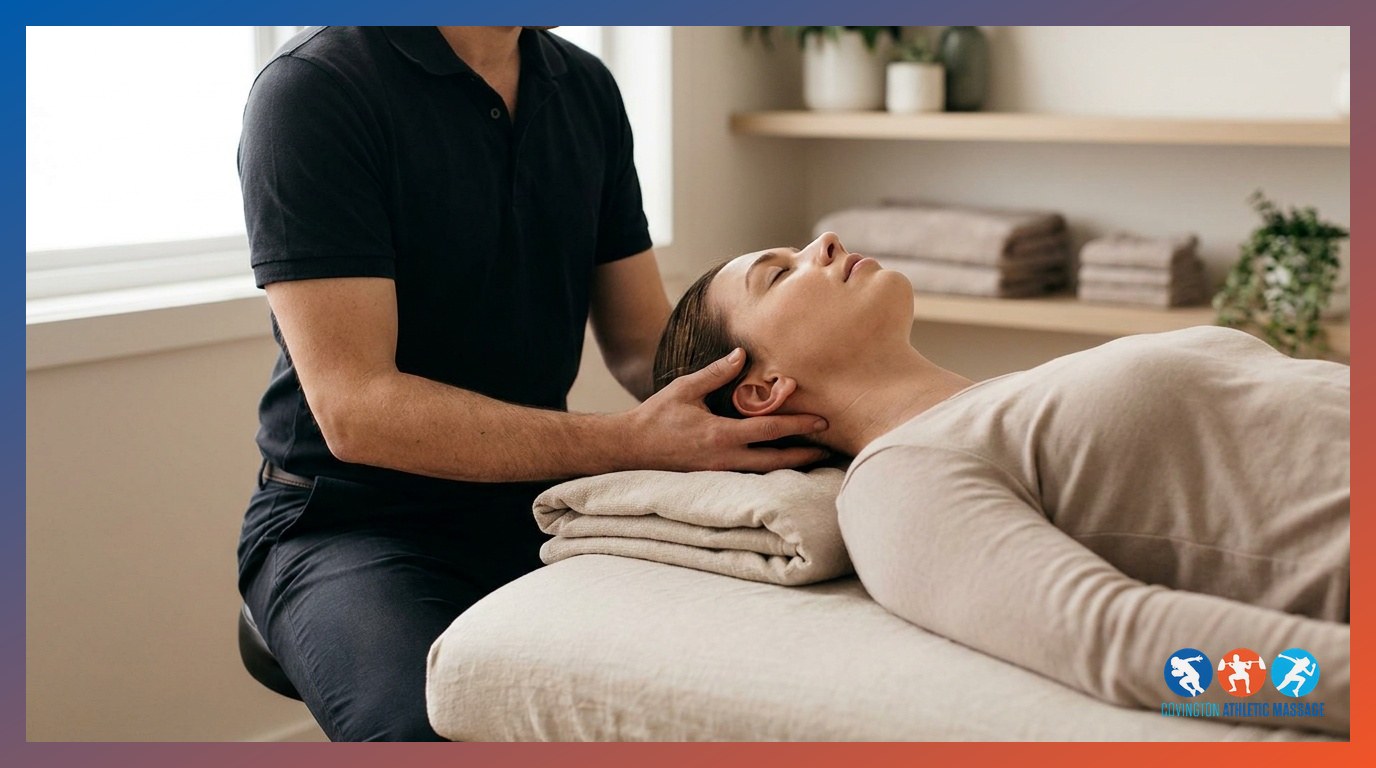
Pain Relief Therapy precedes five condition-specific sub-pillar sessions, and each session follows a protocol built for its region. Neck complaints route to neck pain massage therapy, which concentrates on the upper trapezius and levator scapulae. Head pain that starts at the base of the skull calls for tension headache massage treatment. Lifters and desk workers with a locked-up thoracic spine book upper back tightness relief. The low back pain massage therapy session works the quadratus lumborum, gluteus medius, and piriformis, and hip pain massage therapy targets the deep hip rotators and flexors that running, cycling, and squatting load heavily.
Low back pain is the most commonly presenting complaint at the Covington clinic, hip tension follows for multi-sport athletes, and shoulder tension follows for overhead athletes. That booking pattern tracks with published data: a 2023 Frontiers in Pain Research report puts adult low back pain at 30 to 40 percent, and a 2025 study indexed in PubMed found that 86 percent of overhead athletes with neck and shoulder pain had myofascial pain syndrome, with the trapezius as the most common trigger-point site at 73 percent.
How do I book a Pain Relief Therapy session in Covington, GA?
Covington Athletic Massage has a booking process for Pain Relief Therapy accessible online and by phone for Covington, Georgia athletes, and each athlete selects Pain Relief Therapy as the session type when scheduling an appointment at the Covington clinic.
Athletes book through the Covington Athletic Massage online scheduler or call Covington Athletic Massage directly, selecting pain relief therapy as the session type through either channel. Choosing the correct session type reserves a targeted deep tissue appointment focused on muscular pain rather than a general relaxation session.
First-time athletes complete a brief intake assessment at the start of the first session, and Covington Athletic Massage recommends arriving five minutes early. The intake conversation shapes the entire treatment, so an early arrival preserves the full hands-on treatment time.
Athletes who need regular pain relief sessions as part of an ongoing training cycle can enroll in the athletic massage memberships & programs offered by Covington Athletic Massage. Covington Athletic Massage builds each membership option for consistent repeat care across a demanding training calendar.