
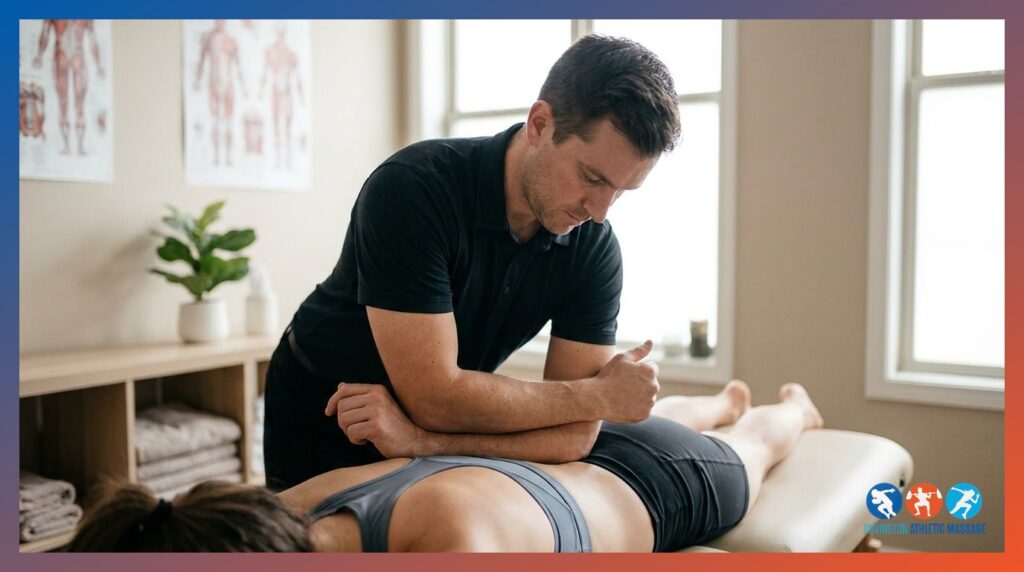
Deep tissue massage therapy relieves low back pain by releasing the lumbar and sacral soft-tissue restrictions behind the symptoms. Tight hip flexors, SI joint stress, and chronic lumbar tension drive athletic low back pain in active adults. Pain relief therapy sessions at the Covington, Georgia clinic target those exact structures. Deep tissue massage succeeds where stretching and rest alone have failed to bring lasting relief.
How does deep tissue massage relieve low back pain?
Deep tissue massage relieves low back pain through four mechanisms: it releases the lumbar erector spinae and thoracolumbar fascia, frees the sacral attachments and piriformis, restores local circulation, and quiets the nervous system activity that keeps back muscles guarded.
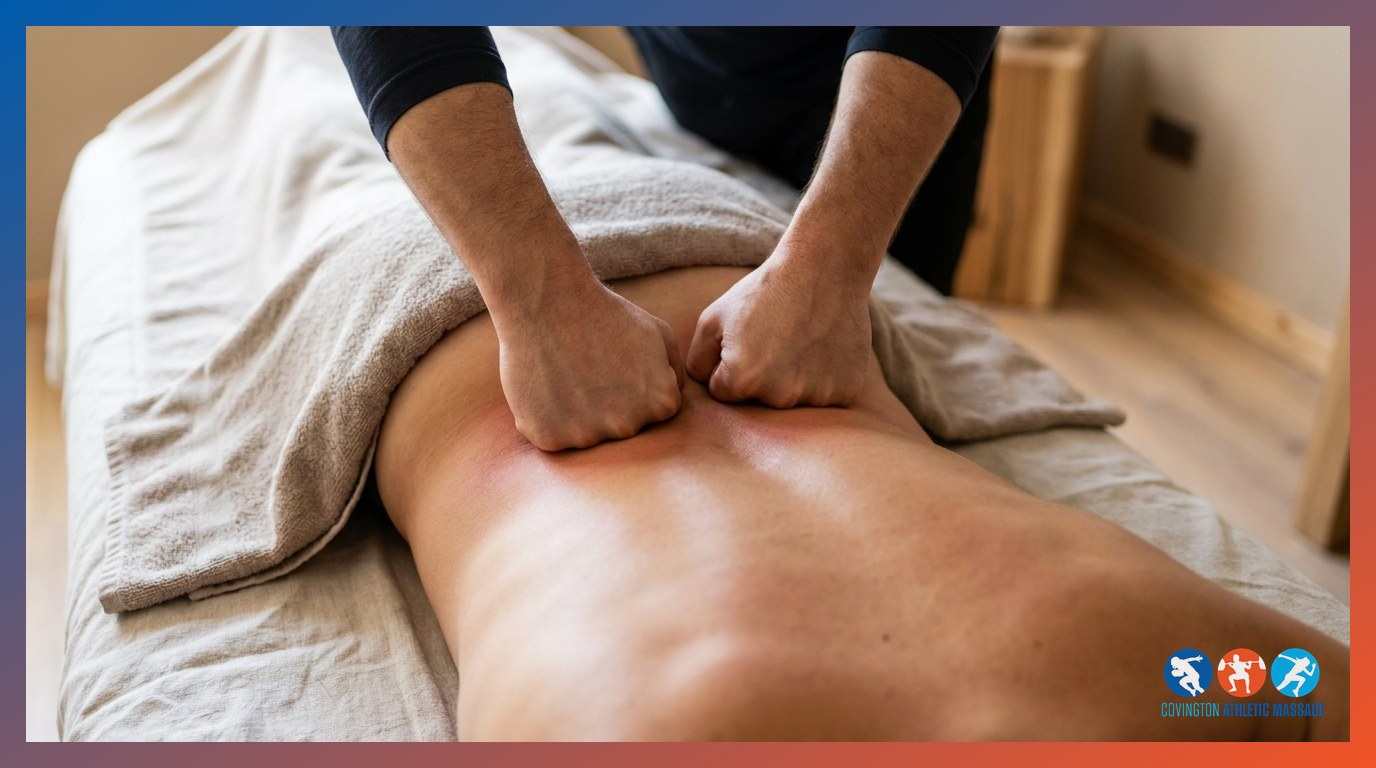
Deep tissue massage treats lumbar paraspinal muscle tension and sacral soft-tissue restrictions in athletes, and each mechanism below removes a distinct pain driver.
1. Myofascial release of the lumbar erectors and thoracolumbar fascia. Chronically shortened erector spinae and a dense thoracolumbar fascia clamp the lumbar spine and increase compressive load on the vertebrae. Slow, sustained pressure lengthens these tissues, which reduces compression and lets the spinal segments move without provoking pain. 2. Sacral attachment and piriformis release. Targeted soft-tissue release of the piriformis, glute medius, and sacral attachments addresses SI joint dysfunction, which frequently refers pain across the low back and into the hip. When the piriformis stops pulling on the sacrum, the joint settles toward neutral and the referred pattern quiets. 3. Restored local circulation. Sustained pressure and release cycles pump blood through previously ischemic tissue. That flow clears the metabolic waste products that sustain trigger-point activity, so knots that keep re-firing finally have the chemistry to switch off. 4. Parasympathetic nervous system activation. According to a 2009 study in the International Journal of Neuroscience, moderate-pressure massage increased high-frequency heart rate variability and decreased the LF/HF ratio, indicating a shift from sympathetic to parasympathetic activity. That shift reduces chronic muscle guarding, which is a primary pain amplifier in long-standing low back cases.
One structure deserves special mention. The quadratus lumborum, a deep muscle connecting the pelvis to the lowest rib, is one of the most commonly overlooked contributors to athletic low back pain and a primary target in the clinic’s deep tissue protocol. Patients often describe QL-driven pain as a deep ache that does not respond to surface-level stretching, because the muscle sits beneath the erectors where stretching cannot reach.
Research on deep tissue massage for low back pain supports this mechanism-based approach. A 2026 Springer study of 21 patients with non-specific low back pain found that a structured 30-minute deep tissue program significantly improved pain perception, range of movement, and functional disability. A 2025 PLOS ONE study measured significant Visual Analog Scale pain reductions after deep tissue application in people with chronic low back pain, confirming a direct analgesic effect.
These mechanisms also separate the work from general relaxation massage. Relaxation massage uses effleurage, broad gliding strokes that spread moderate pressure across the skin to soothe the nervous system without altering any specific structure. Deep tissue work uses directional stripping, where slow, concentrated force travels along the grain of one named muscle or fascial plane, mechanically separating adhered fibers and lengthening shortened tissue. Effleurage never reaches that depth and never applies force along a structure’s length. The clinic’s low back pain relief treatment identifies the exact structure driving the pain, reaches it, and changes it.
What athletic activities and movement patterns cause low back pain that massage can fix?
Running, cycling, weightlifting, rotational sports, and prolonged sitting cause athletic low back pain by shortening hip flexors, inhibiting glutes, and loading the lumbar spine unevenly. Deep tissue massage releases these shortened tissues and restores balanced movement across the hips and pelvis.

The chain starts at the front of the hip. Prolonged athletic loading patterns including running, cycling, and weightlifting cause hip flexor tightness, and hip flexor tightness causes anterior pelvic tilt and increased lumbar compression. The U.S. National Library of Medicine (2024) reports that a shortened iliopsoas tilts the pelvis forward and alters lumbar curvature. A 2023 PubMed Central analysis of low back pain triggers in active people found greater anterior pelvic tilt in subjects with low back pain, with a significant relationship to lumbar lordosis.
The most under-addressed driver of athletic low back pain is these shortened hip flexors rather than the lumbar muscles where the pain is felt. Deep tissue massage corrects the pattern by releasing the iliopsoas and rectus femoris instead of working only the lumbar erectors.
Weightlifting with compromised hip mobility shifts load to the lumbar erectors rather than the glutes. Deadlifts and squats demand deep hip flexion, and when the hips cannot deliver that range, the lower back rounds or arches to close the gap. Overloaded erectors eventually guard and spasm, a sequence documented across the muscle spasm triggers in active people. Restricted hips sit behind these compensations, so hip pain relief for athletes often uses the same release work that settles the back.
Desk hours compound the problem. The prolonged sitting and lumbar stiffness connection keeps the psoas short and switches the glutes off, so an evening run or lift loads the lumbar erectors instead. Glute inhibition forces the lower back to compensate during every stride and rep.
Asymmetric patterns add sacroiliac joint stress. Single-leg dominance and rotational sports like golf and tennis load one side of the pelvis repeatedly, and deep tissue release of the gluteus medius, piriformis, and quadratus lumborum rebalances that demand.
What happens during a pain relief therapy session for low back pain at the clinic?
A pain relief therapy session for low back pain at Covington Athletic Massage Clinic contains assessment of movement pattern, myofascial release of lumbar erectors, and targeted work on hip flexors and glutes. The therapist first identifies whether pain is primarily lumbar, sacral, hip-flexor-driven, or SI-joint-related.
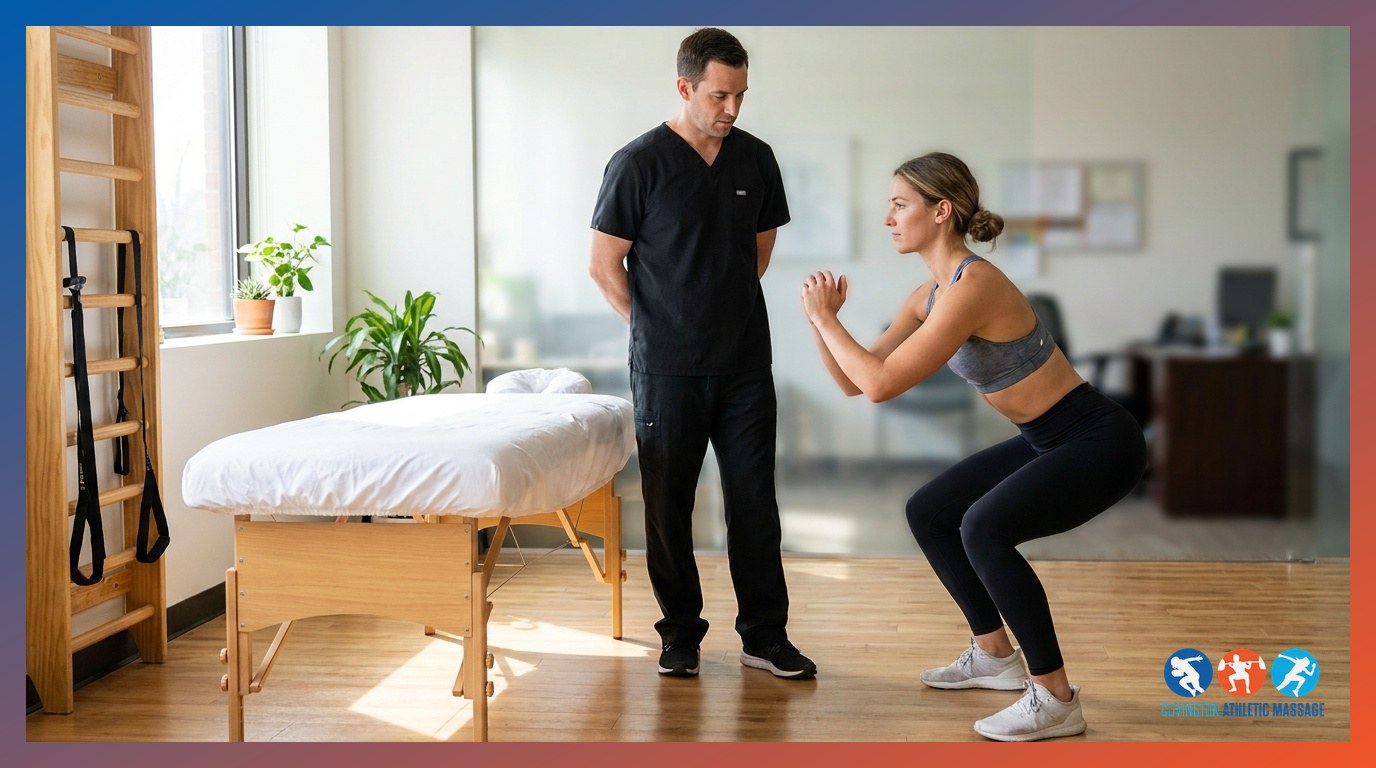
The session opens with an intake and movement assessment. The therapist reviews training history and watches the athlete squat and hinge to see which structures load poorly. Palpation then confirms whether the lumbar spine, sacrum, hip flexors, or SI joint drives the pain, so table time targets the actual source.
Prone work comes first. The therapist applies deep stripping and cross-fiber friction along the lumbar erectors, the quadratus lumborum, and the thoracolumbar fascia. This combination reduces protective guarding in the muscles that brace the lower back under athletic load.
Supine, the therapist releases the hip flexors and iliopsoas to unload the anterior chain, which pulls the pelvis forward when tight. Glute and piriformis work addresses posterior chain tightness and SI joint compression. Side-lying positioning supports specific sacral and hip work: the position allows deeper access to the piriformis and glute medius than prone positioning and is especially important for athletes with SI joint tenderness.
Cadence depends on whether the pain is acute or chronic. Acute soreness responds to wider spacing, while chronic presentations need an inverse taper: symptoms lasting months to years typically require sessions every 5 to 7 days at the start to break the accumulated tissue restriction cycle, then appointments space out as tissue quality improves. Most first-time patients expect the opposite. According to a 2022 study in the Journal of Bodywork and Movement Therapies, massage produced immediate parasympathetic activation during recovery from a single exhaustive muscle contraction exercise, suggesting massage can potentiate recovery between training days. Athletes looking for the drug-free low back relief in Covington GA can schedule an intake assessment at the clinic.
Who is a good candidate for low back pain massage therapy, and when should you see a doctor instead?
Good candidates for low back pain massage therapy present with muscular pain and no neurological symptoms such as numbness, radiating leg pain, or foot weakness. Patients showing red-flag symptoms require physician evaluation before beginning any massage treatment.
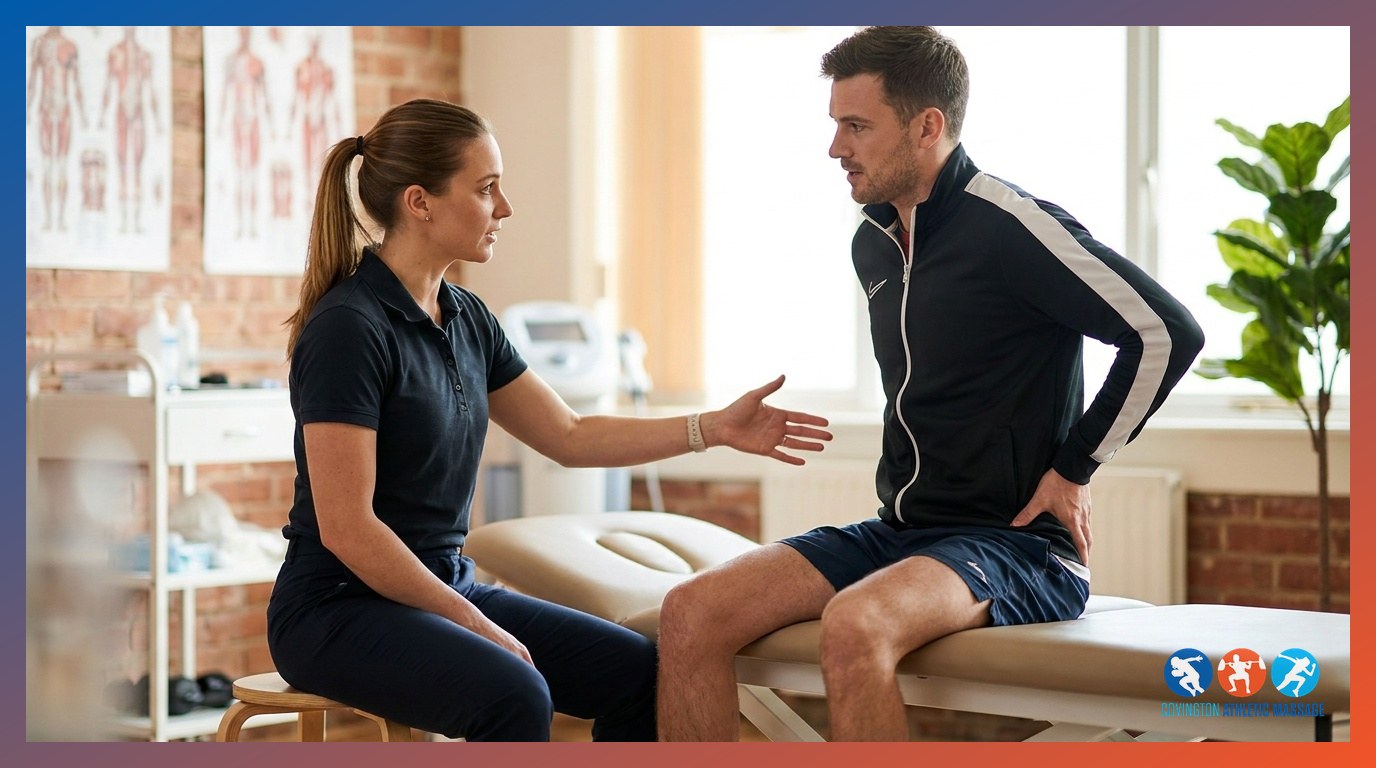
Chronic tension, post-sport soreness, and pain driven by faulty movement patterns respond well to deep tissue massage. The mechanism is soft-tissue release: deep tissue work targets the paraspinals, hip flexors, glutes, and fascia, which reduces compressive load on the lumbar spine and relieves referred muscular pain. The low back pain scenarios suited to massage details which pain presentations respond to that mechanism.
Three red flags require a physician first: pain radiating below the knee, changes in bladder or bowel function, and pain that follows a trauma or fall. These signs point toward structural disc or nerve pathology, and massage does not treat those conditions. Plenty of athletes hear “back pain” and picture a disc injury, so they avoid massage entirely and delay the one treatment their muscular component actually needs.
Chronic low back pain in athletes is distinct from acute disc injury and requires different massage intervention timing. Athletes cleared by a physician after a low back injury are ideal candidates for maintenance massage, since regular sessions prevent the soft-tissue restrictions that contributed to the original injury from rebuilding. Choosing massage or chiropractic for back pain depends on whether the pain is muscular or structural, and an honest assessment at intake sorts the two before any hands-on work begins.
How many massage sessions does it take to relieve low back pain in athletes?
Athletes with acute low back pain typically feel significant relief within one to three deep tissue massage sessions. Chronic low back pain requires an initial block of closer-spaced sessions followed by a maintenance cadence, with total session count depending on how long the tissue has been restricted.
1. Acute low back pain (days to a few weeks): One to three sessions often produce significant relief because the guarding muscles, such as the erector spinae and quadratus lumborum, have not yet developed the fibrotic changes that long-standing tension creates.
2. Chronic low back pain (months to years): Plan weekly or biweekly sessions at first so each visit builds on the previous one before tissue re-tightens, then shift to maintenance every three to six weeks. A 2014 prospective randomized trial published in The Scientific World Journal followed 59 patients with chronic low back pain and found no significant difference in pain reduction or function improvement between patients receiving deep tissue massage alone and patients receiving deep tissue massage combined with NSAIDs.
3. Progress markers between sessions: Athletes should notice improved range of motion in the hip hinge and trunk rotation, shorter and milder morning stiffness, and lower pain during sport-specific movements such as sprinting, squatting, or cutting. Stalled markers signal the plan needs adjusting.
4. Home-care stretching between sessions: Hip flexors, hamstrings, and the thoracolumbar fascia shortened by training loads begin re-tightening within days of a session. Daily stretching holds the length gained on the table, so the next appointment releases new restriction instead of repeating the last one. The six low back stretches between visits target exactly these tissues.
Covington Athletic Massage Clinic serves active adults in Covington, Georgia experiencing athletic low back pain, and the expected massage relief timeline maps session counts to acute and chronic presentations in more detail. Athletes ready to begin can ask about current booking availability and schedule a first session.
Sources
- PLOS ONE, “Back pain in elite sports: A cross-sectional study on 1114 athletes” (2017)
- Springer, “The Development of the Deep Tissue Massage Treatment Procedure for Managing Non-Specific Low Back Pain” (2026)
- PLOS ONE, “Short-term effect after soft tissue manipulation session on subjective and objective parameters in office workers with chronic low back pain: A randomized clinical trial” (2025)
- International Journal of Neuroscience, “Moderate Pressure Massage Elicits a Parasympathetic Nervous System Response” (2009)
- Journal of Bodywork and Movement Therapies, “Acute massage stimulates parasympathetic activation after a single exhaustive muscle contraction exercise” (2022)