
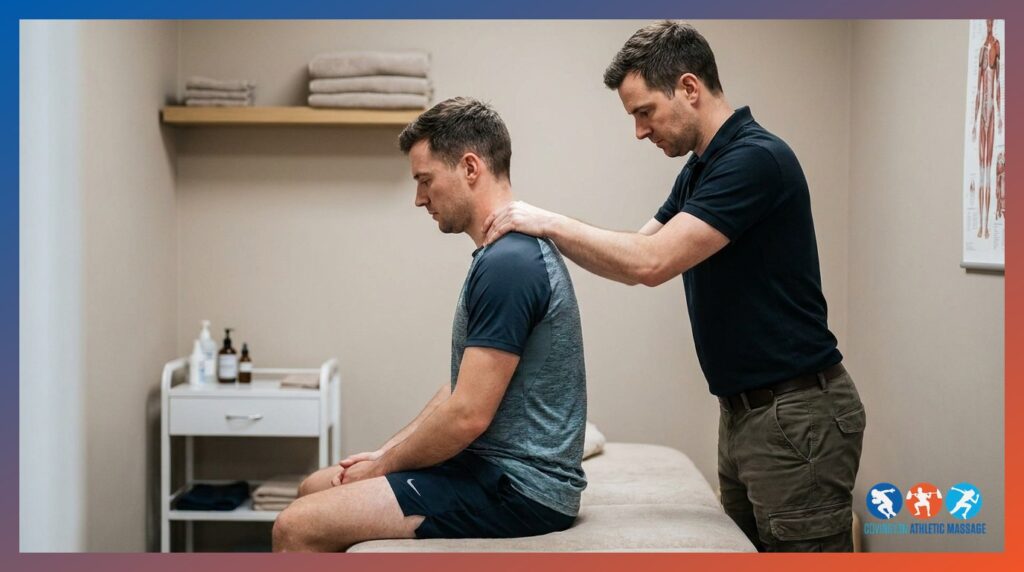
Pain relief therapy for neck pain targets the exact cervical muscles that sport-specific loading patterns tighten and inflame. Athletes in Covington, Georgia develop cervical tension and chronic neck pain from repeated stresses like tackling impact, cycling posture, and overhead lifting. Our clinic’s deep tissue therapists release those overworked muscles with focused sports massage techniques. This targeted approach focuses each session on the specific muscles driving the pain.
What is pain relief therapy for neck pain at a Covington athletic massage clinic?
Pain relief therapy for neck pain is a targeted sports massage session focused exclusively on the cervical region and upper posterior chain, distinct from a full-body relaxation massage. Therapists at the Covington, Georgia clinic apply deep tissue techniques to release cervical tension, restore range of motion, and reduce chronic aching in athletes.
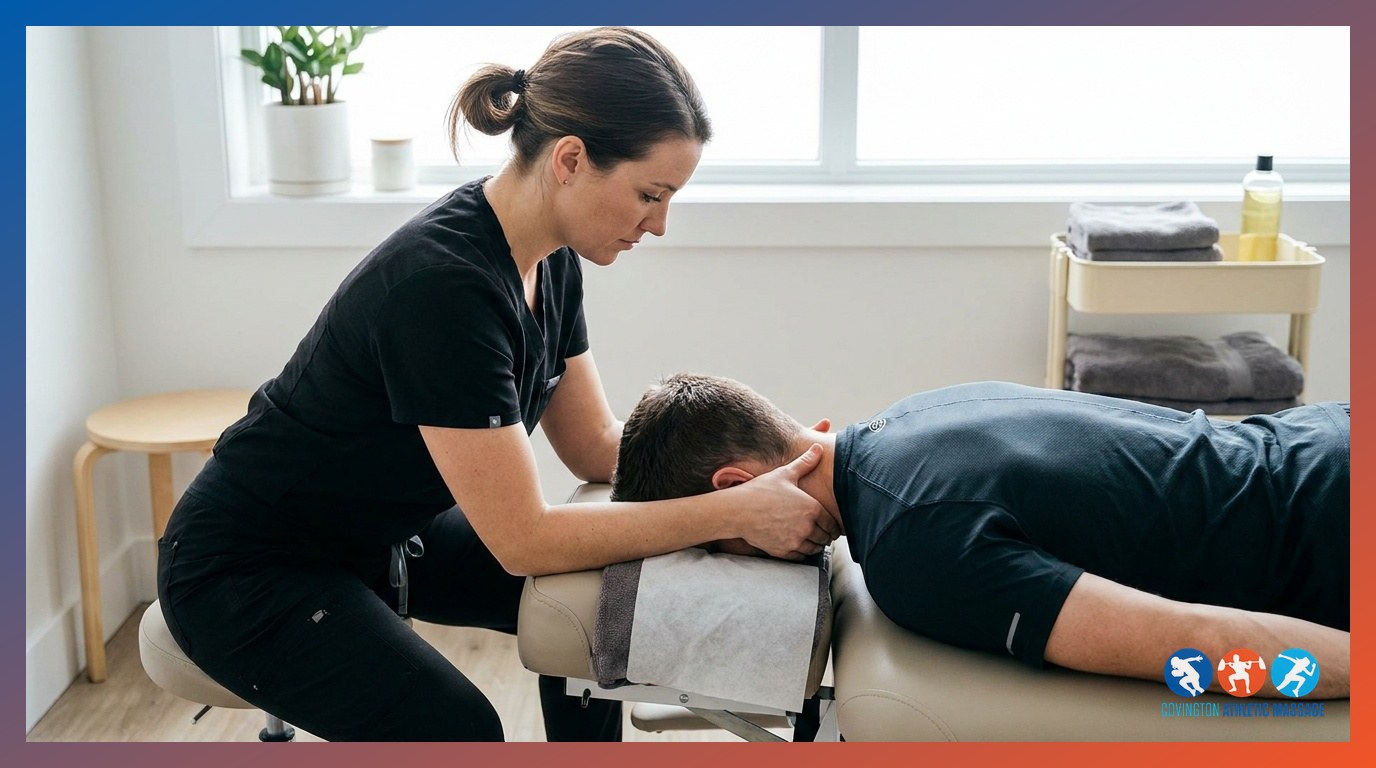
Four root complaints bring athletes to this service: cervical tension, neck stiffness, restricted range of motion, and chronic aching that persists between training sessions. Cervical tension in athletes is caused by sport-specific loading patterns, including contact sport impact, overhead movement, and sustained head-forward posture during training. A pitcher loads the neck differently than a distance cyclist, so the therapist identifies each athlete’s loading pattern before selecting techniques.
A neck pain session at the clinic follows a consistent structure:
- Cervical assessment: the therapist tests rotation, flexion, and extension to locate restricted segments.
- Deep tissue techniques: slow, sustained pressure targets the levator scapulae, upper trapezius, and suboccipital muscles.
- Upper posterior chain work: treatment extends into the muscles that anchor the neck to the shoulders and upper back.
- Home care guidance: the athlete leaves with positioning and mobility advice matched to their sport.
Focused cervical work applies sustained, specific pressure to the muscles that generate neck pain. According to a 2024 PubMed Central review, massage for neck pain probably results in a large reduction in pain in the short term compared with no treatment. The clinic’s neck pain relief therapy keeps sessions concentrated on those pain-generating structures for that reason.
Neck pain massage therapy at the Covington clinic is a service variant of the clinic’s broader Pain Relief Therapy offering, applied specifically to the cervical region. The cervical variant shares anatomy with the clinic’s shoulder and upper back variant and with its tension headache variant, because the upper trapezius and levator scapulae cross all three regions. The primary complaint separates the three: neck pain clients feel stiffness and aching centered in the neck itself, shoulder variant clients report pain in the deltoid and rotator cuff, and tension headache clients describe pain that travels from the base of the skull into the head.
The service is available at the clinic in Covington, Georgia, and athletes book through the Covington GA neck pain clinic intake, which handles scheduling and new-client screening. One boundary matters here. Pain that radiates from the neck into the arm, hand, or fingers points to possible cervical radiculopathy, a nerve condition outside the scope of massage that requires medical evaluation first. The clinic screens every client for radiating symptoms at intake and refers those clients to a physician before any treatment begins.
Which deep tissue techniques does the clinic use to treat neck pain in athletes?
The clinic treats athletic neck pain with trigger point release and myofascial stripping. Deep tissue neck massage targets the upper trapezius, levator scapulae, sternocleidomastoid, and suboccipital muscles, applying sustained pressure to the structures that generate and refer cervical pain.
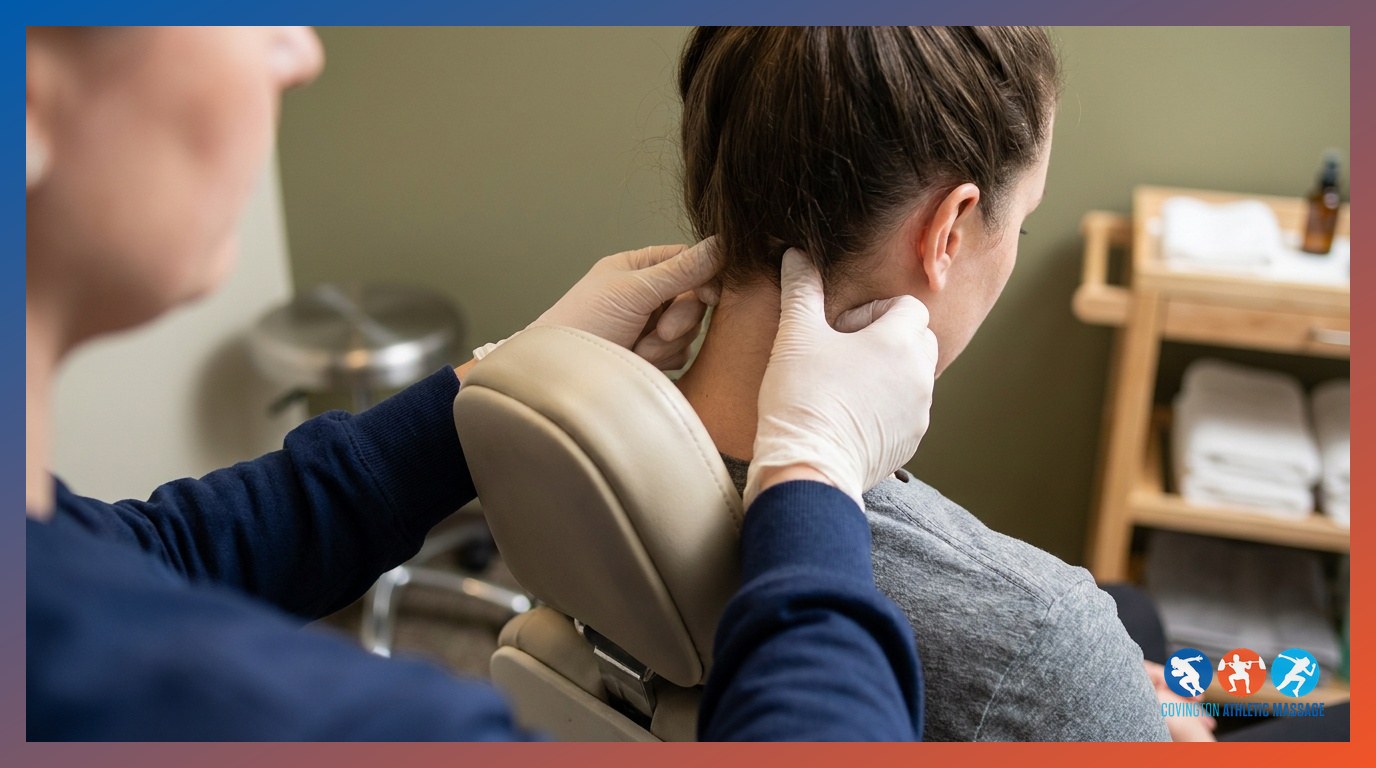
Trigger point release is a core technique used in the clinic’s deep tissue neck pain protocol. The therapist applies sustained pressure to hyperirritable nodules that refer pain into the cervical region and the base of the skull. A 2021 PubMed study found that manual trigger point release significantly improved cervical range of motion and pain ratings over four sessions, outperforming positional release therapy. A 2025 BMC Musculoskeletal Disorders study reports that ischemic compression on the upper trapezius normalizes muscle tone, improves local blood flow, alleviates pain, and restores cervical spine mobility.
Myofascial stripping works the same region lengthwise. The therapist glides slow, deep strokes along the posterior cervical chain to release longitudinal fascial restriction and improve range of motion. According to a 2019 ScienceDirect review, a short course of deep tissue massage, alone or combined with strengthening and stretching exercises, could serve as a treatment option for people with subacute and persistent neck pain.
Athlete sessions concentrate sustained pressure on the posterior cervical chain and the suboccipitals. The therapist adjusts pressure depth and stroke direction to each athlete’s sport and to the restriction found during assessment.
The seven neck muscles causing pain explains each muscle’s referral pattern and its matching release method. The deep tissue neck pain massage walks athletes through what a session involves, from pressure intensity to post-treatment soreness. Athletes whose tension extends past the cervical spine often continue with the shoulder and upper back therapy, and the clinic shows each athlete how neck and shoulder tension develops under training load so sessions can be timed around competition.
How Long Does It Take to Feel Relief from Neck Pain After Massage Therapy?
Most patients feel noticeable relief from acute neck pain within one to two sessions, with reduced muscle tension and improved cervical range of motion. Chronic neck pain requires a structured plan of three to six sessions with decreasing frequency. The pain relief timeline for neck pain depends on whether the presentation is acute or chronic.
1. First session: Deep tissue work on the posterior cervical chain produces immediate relief. Most patients notice this initial relief fade within a few days. Mild soreness in the cervical region lasting 12 to 24 hours afterward is normal, particularly when the trapezius and levator scapulae have not been worked deeply before. 2. Acute neck pain, sessions one to two: Recent-onset pain with a clear cause, such as a hard training block or a slept-wrong morning, typically shows noticeable tension reduction and improved range of motion within one to two sessions. 3. Chronic neck pain, sessions three to six: Stiffness that has persisted for months or years resolves through a multi-session plan with declining frequency, not indefinite weekly treatment.
According to a 2014 Annals of Family Medicine study, 60-minute massage treatments two to three times per week significantly increased the likelihood of clinically meaningful improvement in chronic neck pain. A 2024 PubMed (NCBI/NIH) analysis reported a clinically important difference favoring higher doses of at least eight sessions of 30 minutes or more over four weeks.
The optimal session spacing for neck pain shifts as symptoms resolve, and knowing how often to get massage for neck pain helps athletes plan that taper. Recognizing when neck pain becomes chronic matters because the treatment plan changes at that threshold. Athletes weighing chronic vs acute neck pain massage approaches will find each presentation demands a different technique mix. Many patients who book neck work also find headache relief through massage, since cervical tension frequently feeds tension headaches.
Which Athletes Benefit Most from Neck Pain Massage Therapy?
Contact sport athletes, overhead athletes, and endurance athletes benefit most from neck pain massage therapy. Football and wrestling players carry collision-related cervical compression, swimmers and pitchers overload the levator scapulae, and cyclists develop suboccipital strain. Each profile needs different muscle sequencing.
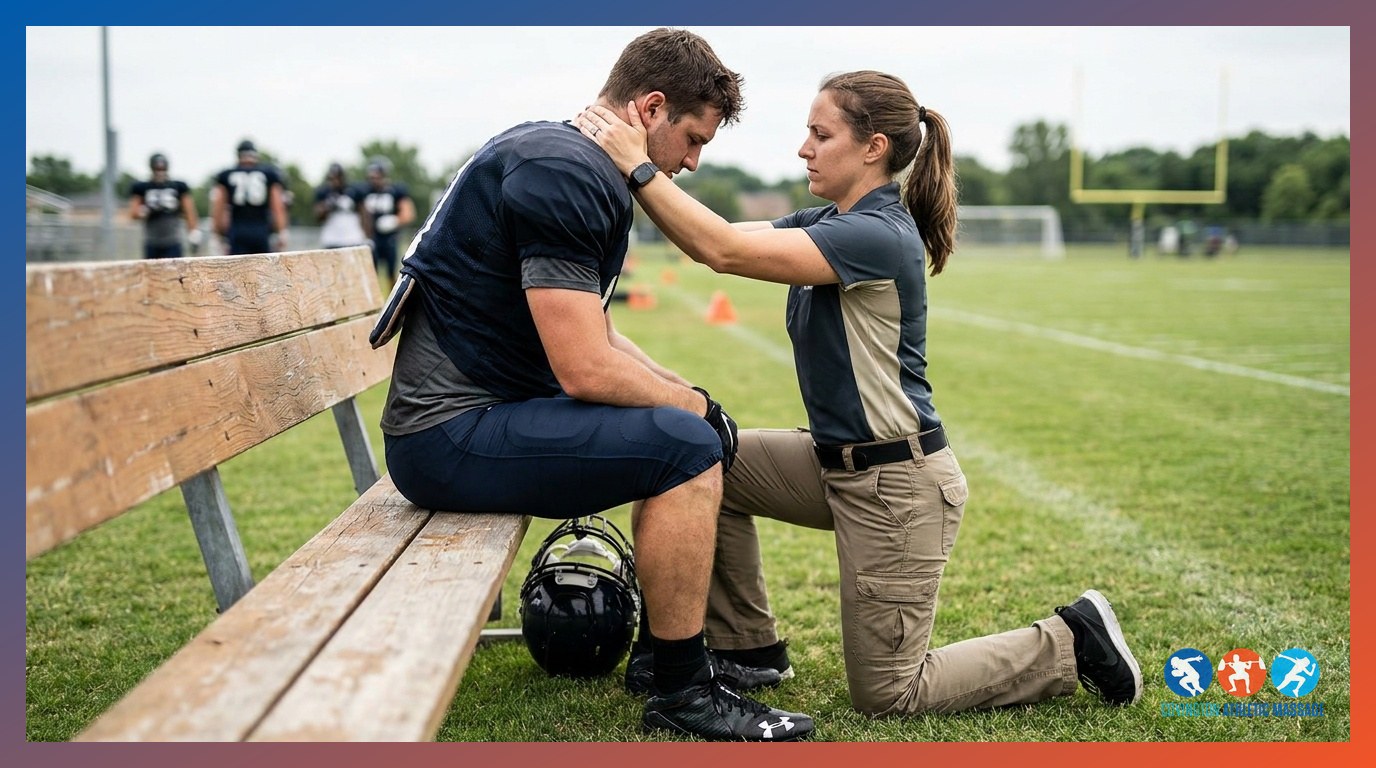
Contact sport athletes in football, wrestling, and rugby absorb cervical compression and whiplash-pattern tension from repeated collision loading. Their treatment sequences the scalenes and deep cervical extensors before the superficial muscles. These athletes often recognize their own symptoms in the training-related neck pain causes that follow impact sports.
Overhead athletes such as swimmers, baseball pitchers, and volleyball players chronically overload the levator scapulae and upper trapezius through repetitive arm-elevation mechanics. A 2026 Musculoskeletal Care study found myofascial pain syndrome in 86% of overhead athletes with neck and shoulder pain. Their sessions release the levator scapulae and upper trapezius before the suboccipitals.
Endurance athletes, especially cyclists and runners, hold a sustained forward-head posture that compresses the suboccipitals and shortens the sternocleidomastoid. Physiopedia reports that a cyclist’s head sits forward of the shoulders, which raises the muscular load on cervical tissues. Their sessions lead with suboccipital decompression and sternocleidomastoid lengthening. The runners experiencing post-run neck pain who visit our Covington clinic learn to tell ordinary soreness apart from genuine warning signs.
The clearest beneficiaries are athletes whose sport produces a structurally distinct tension pattern, because contact and overhead athletes require different sequencing than a cyclist with forward-head posture. Athletes with chronic neck stiffness benefit most from regular deep tissue cervical massage at a cadence matched to training load. Desk-working athletes add long computer hours to training, so they present a combined posture-and-sport pattern that demands extra suboccipital attention compared with sport-only athletes. Covington-area athletes can find region-specific resources and booking details in Neck Pain Relief in Covington, GA: Local Athlete Guide.
Sources
- Physiopedia, “Cyclist’s Neck”
- PubMed (NCBI/NIH), “Neck Pain in Multisport Athletes” (2007)
- PubMed (NCBI/NIH), “Massage for neck pain” (2024)
- Annals of Family Medicine, “Five-Week Outcomes From a Dosing Trial of Therapeutic Massage for Chronic Neck Pain” (2014)
- PubMed (NCBI/NIH), “Immediate effects of positional release therapy and manual trigger point release on neck pain and range of motion in computer users with upper trapezitis” (2021)
- PubMed (NCBI/NIH), “Prevalence of Acute Neck Pain Following Sports-Related Concussion in High School Athletes” (2022)