
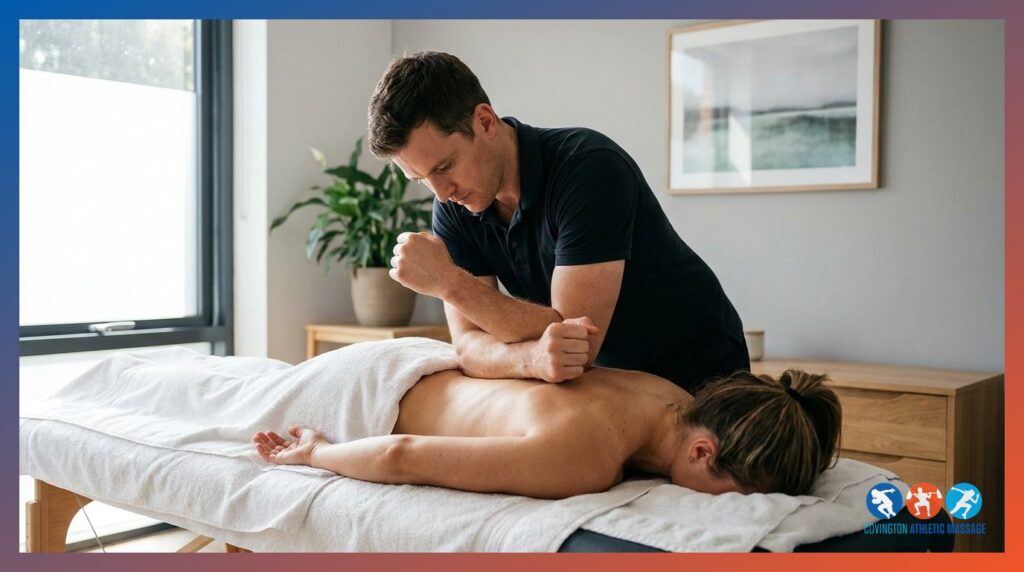
Athletic recovery works as an integrated system of sleep, nutrition, active recovery work, and targeted soft-tissue therapy, and each pillar strengthens the others. Athletes who treat recovery as isolated habits leave measurable performance on the table. Sports massage carries the soft-tissue load in that system, releasing the adhesions and muscle tension that rest alone cannot resolve. Covington Athletic Massage provides deep tissue sports massage that anchors a complete recovery system for athletes training and competing in Covington, Georgia.
What is athletic recovery and why does it require a system, not just rest?
Athletic recovery is the physiological process of tissue repair, neuromuscular restoration, and energy substrate replenishment following training stress. Athletic recovery requires a system rather than rest alone because rest stops loading without actively driving repair, circulation, or metabolic waste clearance.
Athletic recovery is a multi-pillar system requiring sleep, nutrition, active recovery, and soft-tissue work to function optimally. Each of the four pillars addresses a distinct physiological mechanism:
- Sleep drives the hormonal environment for repair, including the growth hormone release that supports tissue rebuilding during deep sleep.
- Nutrition supplies the raw materials, delivering amino acids for protein synthesis and carbohydrate for glycogen restoration.
- Active recovery uses low-intensity movement to sustain circulation and clear metabolic byproducts from worked muscles.
- Soft-tissue therapy such as sports massage addresses localized tissue quality, releasing adhesions and improving blood flow within muscle and fascia.
Rest alone is an incomplete strategy. Rest is passive. Rest removes mechanical loading, which prevents further breakdown, but circulation slows and metabolic waste lingers in the tissue during stillness. Repair is an active construction process that demands inputs, and stillness supplies none of those inputs.
The hours after training form an adaptation window. During the adaptation window, the recovery inputs an athlete provides determine whether the training stress becomes adaptation or injury. Well-supported tissue remodels stronger, while the microdamage accumulating in under-supported tissue eventually produces a strain or an overuse injury.
The prevailing misconception in athlete-facing recovery content treats each modality as independently sufficient: sleep enough, or eat well, or book a massage, and recovery is handled. The corrected view replaces the misconception with a declared principle: athletic recovery pillars are physiologically sequential and interdependent, not independently sufficient. Inadequate sleep blunts the protein synthesis that good nutrition enables, so even a well-built diet underperforms after short nights. Soft-tissue work delivers the most benefit when systemic recovery is adequate, because an athlete in an energy deficit from poor nutrition lacks the resources to rebuild the tissue that massage stimulates. One weak pillar quietly taxes the other three.
What is delayed onset muscle soreness and what actually causes it?
Delayed onset muscle soreness (DOMS) is the muscular pain and stiffness that peaks 24 to 72 hours after unfamiliar or high-intensity eccentric exercise. Eccentric muscle contractions produce micro-tears in muscle fibers that trigger an acute inflammatory response; lactic acid accumulation does not cause delayed onset muscle soreness.
According to the Cleveland Clinic (2026), muscles contain thousands of small fibers that develop tiny tears during exercise, and eccentric work, where a muscle tenses while lengthening, is the most likely trigger. Lactic acid clears from muscle tissue within hours of a session, so lactic acid accumulation cannot explain soreness that arrives a day later, yet the lactic acid explanation remains a widespread athlete misconception.
Delayed onset muscle soreness peaks 24 to 72 hours after training, NOT immediately after, meaning the soreness an athlete feels the morning after a hard session is not a signal to rest completely. A 2022 paper in the Journal of Functional Morphology and Kinesiology reports that pain typically starts about 8 hours post-exercise and peaks at 1 to 2 days, alongside stiffness, swelling, and reduced joint range of motion.
Delayed onset muscle soreness is also not a reliable proxy for training quality or recovery need. Novel movements produce heavy soreness even in well-trained athletes, while productive training blocks often produce little soreness once the body adapts, so judging a program by soreness alone misreads both ends.
Three recovery pillars directly reduce the severity and duration of delayed onset muscle soreness:
- Light active recovery on day one. Easy movement improves blood flow to damaged tissue before inflammation peaks, which reduces soreness severity on day two.
- Adequate sleep. Sleep drives the hormonal signaling and tissue repair that resolve inflammation.
- Protein intake. Protein supplies the amino acids that rebuild torn fibers.
Why is sleep the most important pillar of athletic recovery?
Sleep is the highest-leverage recovery pillar because deep sleep provides the primary daily window for human growth hormone release and muscle protein synthesis. No other recovery method matches the tissue repair and hormonal reset that consistent sleep delivers every night.
During slow-wave sleep, the body releases growth hormone at peak concentration, and that hormone drives muscle protein synthesis and the repair of training-damaged tissue. According to Rising Researchers (2023), growth hormone increases during deep slow-wave sleep while cortisol decreases during early sleep and melatonin and testosterone rise. EFECTIV Nutrition reports that controlled studies show sleep restriction directly lowers muscle protein synthesis, cutting into the very adaptation athletes train for. Together, these overnight hormonal mechanics define sleep’s role in physical restoration.
The costs of short sleep are measurable. EFECTIV Nutrition reports that after sleep deprivation, plasma cortisol runs 21% higher and plasma testosterone 24% lower the following day. The Gatorade Sports Science Institute links chronic sleep deprivation in athletes to delayed recovery and greater injury risk. Reaction time slows under sleep loss. Sleep deprivation also impairs glycogen replenishment, so muscles arrive at the next session under-fueled. A 2024 meta-analysis of 27 studies in Nature and Science of Sleep found that acute sleep deprivation significantly reduced overall athletic performance, with an effect size of -0.56 across 75 performance indicators.
Most athletes under training load recover best on 7 to 9 hours per night. When nighttime sleep falls short, a 20 to 30 minute nap adds meaningful restoration without the grogginess of longer daytime sleep.
Massage therapy supports sleep quality by activating the parasympathetic nervous system and releasing the neuromuscular tension that keeps athletes restless. Evening trainees face a specific challenge: elevated core temperature and cortisol after training suppress melatonin onset. A proper cool-down routine and avoiding blue light are the two most effective fixes.
What should athletes eat and when to maximize recovery?
Athletes maximize recovery by consuming 20 to 40 grams of high-quality protein with carbohydrate within 30 to 60 minutes after training, restoring muscle glycogen, replacing fluids and electrolytes, and choosing leucine-rich foods that trigger muscle protein synthesis.

Post-workout nutrition timing applies to the 30 to 60 minute anabolic window after training, when the muscle protein synthesis rate is highest. Pairing protein with carbohydrate inside that window rebuilds damaged fibers and refills glycogen stores at the fastest rate the body allows.
Protein quantity matters as much as timing. According to 2016 University of Stirling research published in Physiological Reports, 20 to 25 grams of protein maximally stimulates myofibrillar protein synthesis after resistance exercise, while 40 grams proved superior to 20 grams following whole-body resistance sessions. Leucine acts as the key anabolic trigger, so eggs, dairy, and lean meat anchor a strong recovery meal. The post-exercise nutrition for tissue repair covers how those protein and carbohydrate choices support healing between sessions.
Carbohydrate restores muscle glycogen, a non-negotiable recovery input for athletes training on consecutive days. Athletes who skip carbohydrate start the next session with depleted glycogen stores.
Hydration and electrolyte replacement drive recovery as directly as they drive performance. Dehydration impairs tissue repair and reduces massage therapy effectiveness, because hypohydrated muscle responds poorly to massage therapy.
Among supplements, creatine monohydrate carries the strongest evidence for recovery in strength and power athletes, accelerating phosphocreatine replenishment and reducing markers of muscle cell damage.
What is active recovery and when should athletes use it instead of complete rest?
Active recovery is low-intensity movement performed at 40 to 60 percent of maximum heart rate that promotes blood flow and metabolic waste clearance without adding significant training stress, and athletes use active recovery on the day following hard training instead of complete rest. Gentle movement accelerates lactate clearance and reduces delayed-onset muscle soreness more than stillness does.

Active recovery precedes passive recovery modalities in the immediate post-training window because low-intensity movement accelerates lactate clearance before the body enters full rest. Moving beats lying down for clearing the byproducts of hard effort.
Four modalities qualify as active recovery, and each matches a specific training type. Easy swimming is the most effective option after high-impact training such as running or plyometrics, because water supports body weight while flushing the legs with zero impact. Walking and easy cycling are the most effective options after lower-body strength or endurance sessions, because direct leg turnover clears local fatigue fastest. Light yoga is the most effective option after heavy lifting or power blocks, because mobility work restores range of motion that loaded training restricts. Foam rolling is an effective supplement for any training type, because self-massage loosens worked tissue without adding cardiovascular demand.
Complete passive rest is the correct choice in three situations: acute injury, illness, or accumulated fatigue that has crossed into overtraining territory. An athlete managing a running injury should follow rehabilitation strategies for injured runners before returning to any recovery movement.
Two passive tools still earn a place around active recovery days. Ice baths reduce acute inflammation and work best in the 24 hours immediately post-training, but frequent use blunts the chronic adaptation response, making cold immersion a situational tool rather than a daily default. Compression garments worn during the one to four hours post-training reduce fluid accumulation in worked muscles and carry consistent evidence for reducing soreness without interfering with adaptation.
How does sports massage fit into a complete athlete recovery system?
Athletes use sports massage as the professional soft-tissue pillar of a complete recovery system: a structured intervention that increases local circulation, reduces neuromuscular tension, breaks down adhesions, and clears metabolic waste to accelerate the recovery cycle alongside sleep, nutrition, and active recovery. Athletes who apply the sports massage fundamentals for training shorten the time between hard sessions.
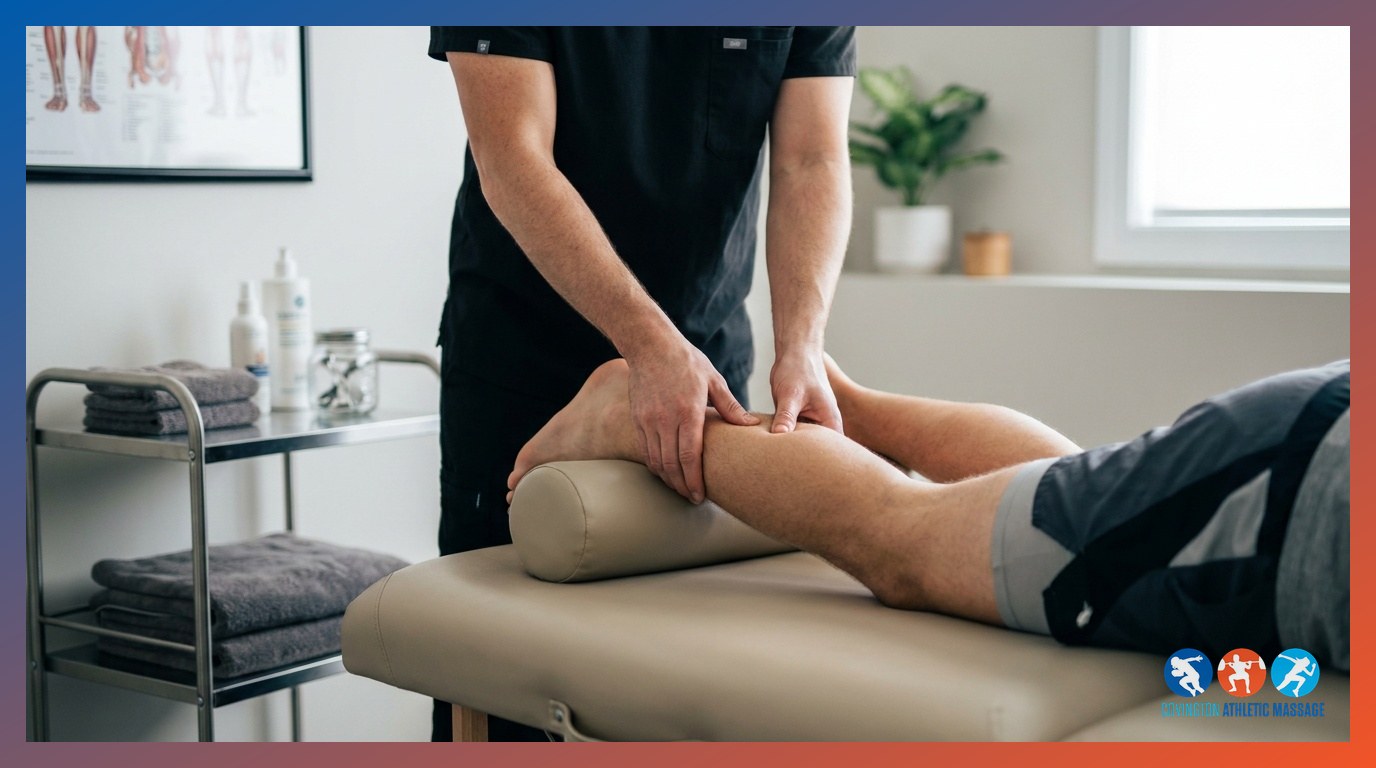
Deep tissue massage reaches dense, chronically loaded tissue layers that foam rolling and stretching cannot reach. Timing determines the value of deep tissue work. Sports massage delivers the strongest effect 24 to 48 hours after intense training, and deep tissue work applied within the first two hours post-training can interfere with the acute inflammatory response that initiates muscle repair.
A complete protocol assigns each session a distinct job:
1. Maintenance sessions support regular recovery during normal training weeks. 2. Pre-event sessions build activation and readiness before competition. 3. Post-event sessions provide acute recovery support after competition.
Athletes in Covington, Georgia use Covington Athletic Massage as the professional soft-tissue anchor of a complete recovery system, scheduled as a standing therapeutic intervention rather than an occasional treat. Local athletes map each Covington athlete recovery massage session onto the training week, and complementary therapies used alongside massage sustain the gains between appointments.
Runners face sport-specific demands. The plantar fascia, IT band, and calf complex are repetitive-stress tissues that benefit from targeted soft-tissue work distinct from the full body massage recovery methods applied to general whole-body recovery.
How should athletes structure their recovery week to avoid cumulative breakdown?
Athletes avoid cumulative breakdown by spacing hard sessions 48 to 72 hours apart, alternating hard days with active recovery and full rest days, and booking professional massage after the hardest training days of the week.
Recovery is the adaptation window itself, not the absence of training stress. Recovery protocol timing applies to a 24 to 72 hour post-training window during which each recovery pillar has a distinct and non-interchangeable role. Inside that window, muscle fibers rebuild and the nervous system recalibrates. Training again before the window closes builds a recovery debt that compounds into overuse injury, such as tendinopathy, not simple fatigue.
A practical recovery week repeats four blocks:
1. Hard training days: high-intensity or heavy-volume sessions, spaced so each adaptation window closes before the next hard effort. 2. Active recovery days: low-intensity movement like walking or easy cycling, which raises blood flow without adding training stress. 3. Full rest days: at least one per week, giving connective tissue and the nervous system complete downtime. 4. Professional massage sessions: booked 24 to 48 hours after the hardest session or on the rest day, landing inside the adaptation window.
The same window logic drives structuring a daily athlete recovery plan, which assigns sleep, nutrition, and mobility to set hours after each session.
Four warning signs tell an athlete that recovery is falling behind training load:
- Soreness lasting beyond 72 hours after a session
- Declining performance at previously manageable loads
- Disrupted sleep, especially trouble staying asleep
- Elevated resting heart rate measured on waking
Because these signals arrive quietly, quantifying training stress and massage response turns them into measurable trends.
Periodizing recovery mirrors periodizing training load. Plans already alternate buildup weeks with deload weeks, and recovery investment rides the same wave: massage frequency, sleep targets, and rest days all scale up during heavy blocks. Recovery scheduling carries the same weight as training scheduling, because the deload is where cumulative debt gets paid down.