Sports Massage for Specific Conditions
Sports massage treats the specific muscular conditions that sideline athletes in Covington, Georgia. Covington Athletic Massage applies deep tissue sports massage protocols to sciatica, shin splints, rotator cuff pain, IT band syndrome, and plantar fasciitis, targeting the soft-tissue root causes that general massage and medication leave unresolved. Each protocol matches the condition’s anatomy, so injured and active patients receive work built for their diagnosis rather than a generic full-body session.
Which athletic conditions does Covington Athletic Massage treat with sports massage?
Covington Athletic Massage treats condition-specific athletic soft-tissue injuries, including sciatica and piriformis syndrome, shin splints, IT band syndrome, plantar fasciitis, rotator cuff pain and shoulder impingement, Achilles and patellar tendinopathy, thoracic outlet syndrome, and general lower back and hip pain.
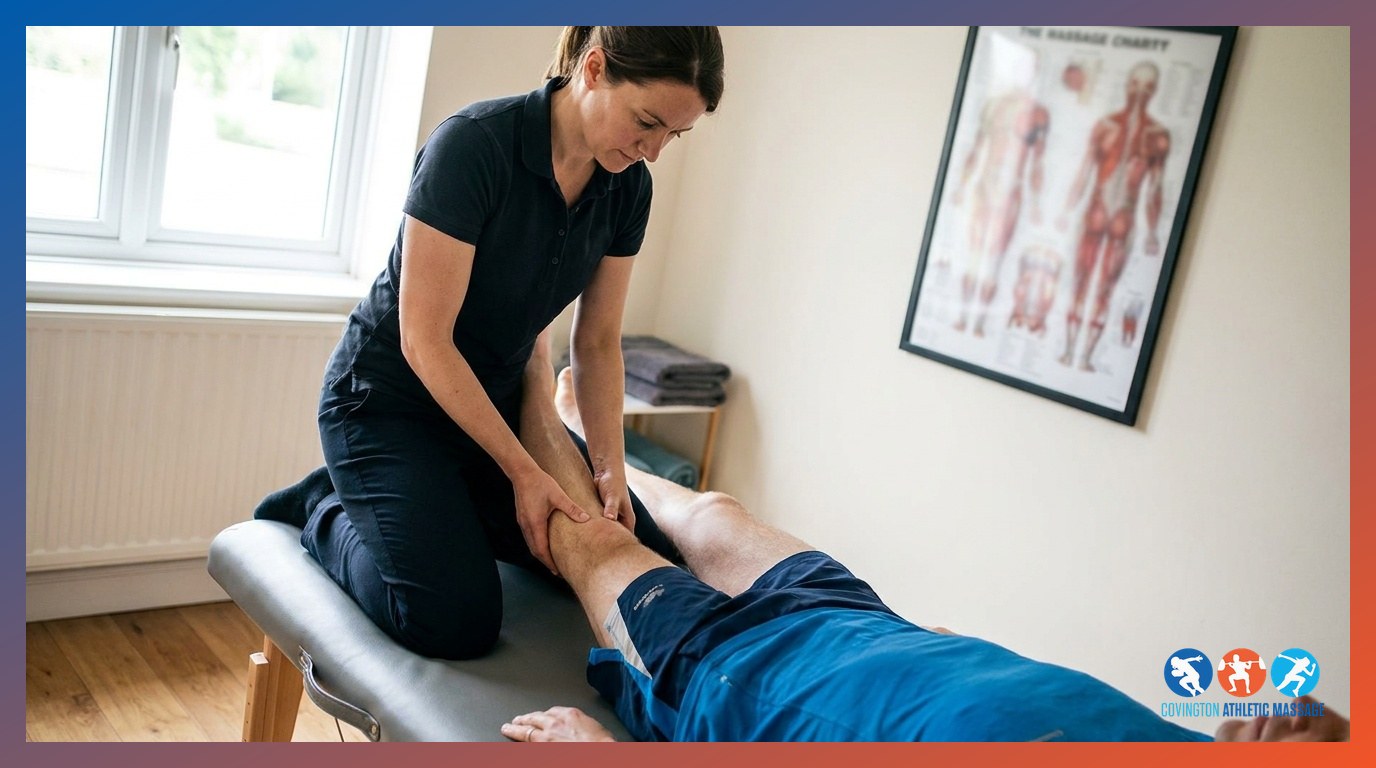
Every condition on that list shares one feature: a soft-tissue muscular component that hands-on work can reach directly. Deep tissue sports massage addresses the muscular and fascial root causes underlying condition-specific athletic pain, not merely surface-level symptom relief.
General sports massage is a full-body session that works the major muscle groups in sequence to support recovery, circulation, and training readiness. Condition-specific treatment is a targeted protocol: the therapist isolates the muscles driving one diagnosed problem, works those tissues with slower, deeper strokes, and reassesses that condition’s symptoms between visits.
Many Covington athletes book after a diagnosis but before, or instead of, surgery. For piriformis-driven sciatica and sub-acromial shoulder impingement, deep tissue work on the surrounding musculature can reduce symptom severity enough to delay or avoid an operation, a clinically meaningful outcome that general massage-for-pain care does not target and general massage-for-pain pages do not specify.
Shin splints illustrate this well. According to a 2024 Cureus review, medial tibial stress syndrome affects 13.6% to 20% of runners and up to 35% of military recruits, and Physiopedia reports the syndrome in roughly 20% of dancers. The same review traces the pain to traction periostitis, persistent tendon traction inflaming the periosteum along the medial tibia, so the clinic’s massage treatment for shin splint pain concentrates on the soleus and deep calf compartment rather than the bone itself.
The same reasoning governs the tendon conditions. Achilles tendinopathy responds through the calf complex and patellar tendinopathy through the quadriceps and hip flexors, because the tendon itself lacks the blood supply and contractile tissue that massage directly affects, just as with IT band syndrome. Dedicated protocols for sciatica and nerve pain, shin splints and lower leg pain, and thoracic outlet syndrome and upper extremity pain apply this tissue-by-tissue logic, and the sports injury conditions overview maps each condition to its primary muscle groups.
Lower back and hip pain without a formal diagnosis is among the most common presentations at the clinic, so no referral or condition name is required. Each visit opens with a condition-oriented intake: the therapist takes a pain history, tests movement, and identifies the primary pain-generating muscles, and patients booking ahead simply note their diagnosis or where the pain sits.
How does sports massage help sciatica and piriformis-related nerve pain?
Sports massage relieves sciatica and piriformis-related nerve pain by releasing the tight piriformis and deep hip rotator muscles that compress or irritate the adjacent sciatic nerve. As the piriformis softens, mechanical pressure on the nerve drops and radiating leg pain subsides.
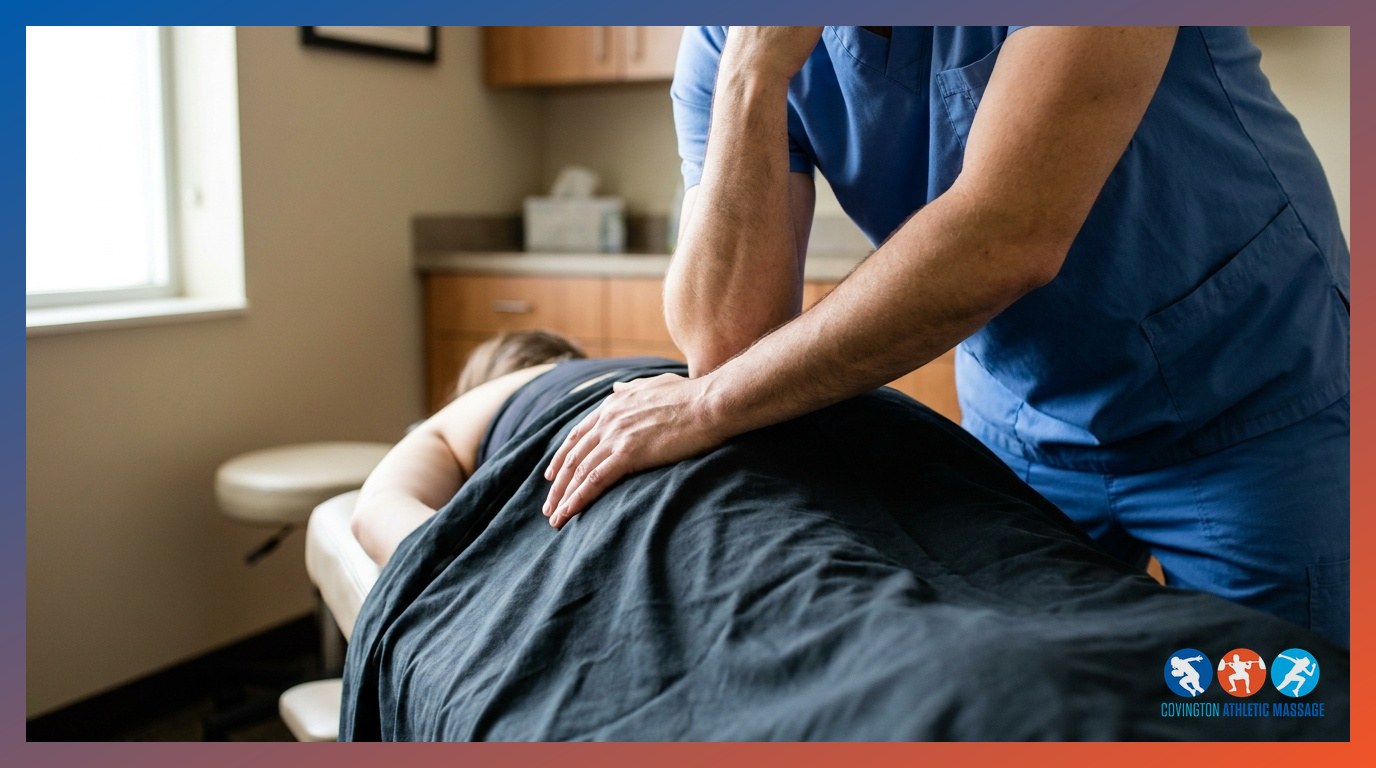
For most athletes with these symptoms, the driver is soft tissue rather than a spinal disc. A shortened, overworked piriformis squeezes the sciatic nerve deep in the hip, producing the pattern clinicians call pseudo-sciatica. Piriformis syndrome accounts for an estimated 2.4 million cases of low back pain and sciatica annually in the United States, according to a 2025 report in the Insights Journal of Health and Rehabilitation.
Deep tissue release works through a simple sequence:
1. Release. The therapist applies slow, sustained pressure into the piriformis and deep hip rotators, lengthening the shortened fibers. 2. Decompress. The softened piriformis stops pressing on the adjacent sciatic nerve. 3. Relieve. With compression reduced, the nerve calms and leg symptoms fade.
The most susceptible athletes are runners and cyclists, because repetitive strides and pedal strokes shorten the deep hip rotators. Anyone who pairs long hours of sitting with a heavy training load carries similar risk. A 2025 BMC Surgery study found that 38.2% of piriformis syndrome patients had vigorous physical activity or sport as the precipitating stressor, and a 2026 Sports (MDPI) analysis describes the condition as understudied in athletic populations.
The Sciatica and Nerve Pain Massage page details the clinic’s massage therapy for nerve pain conditions, including how sessions address piriformis-related sciatica.
Can sports massage treat IT band syndrome and lateral knee pain?
Yes. Sports massage treats IT band syndrome and lateral knee pain by releasing the muscles that load the band, not by working on the band itself. Deep tissue treatment targets the tensor fasciae latae, gluteus medius, and lateral quadriceps, whose chronic tension produces the knee symptoms.
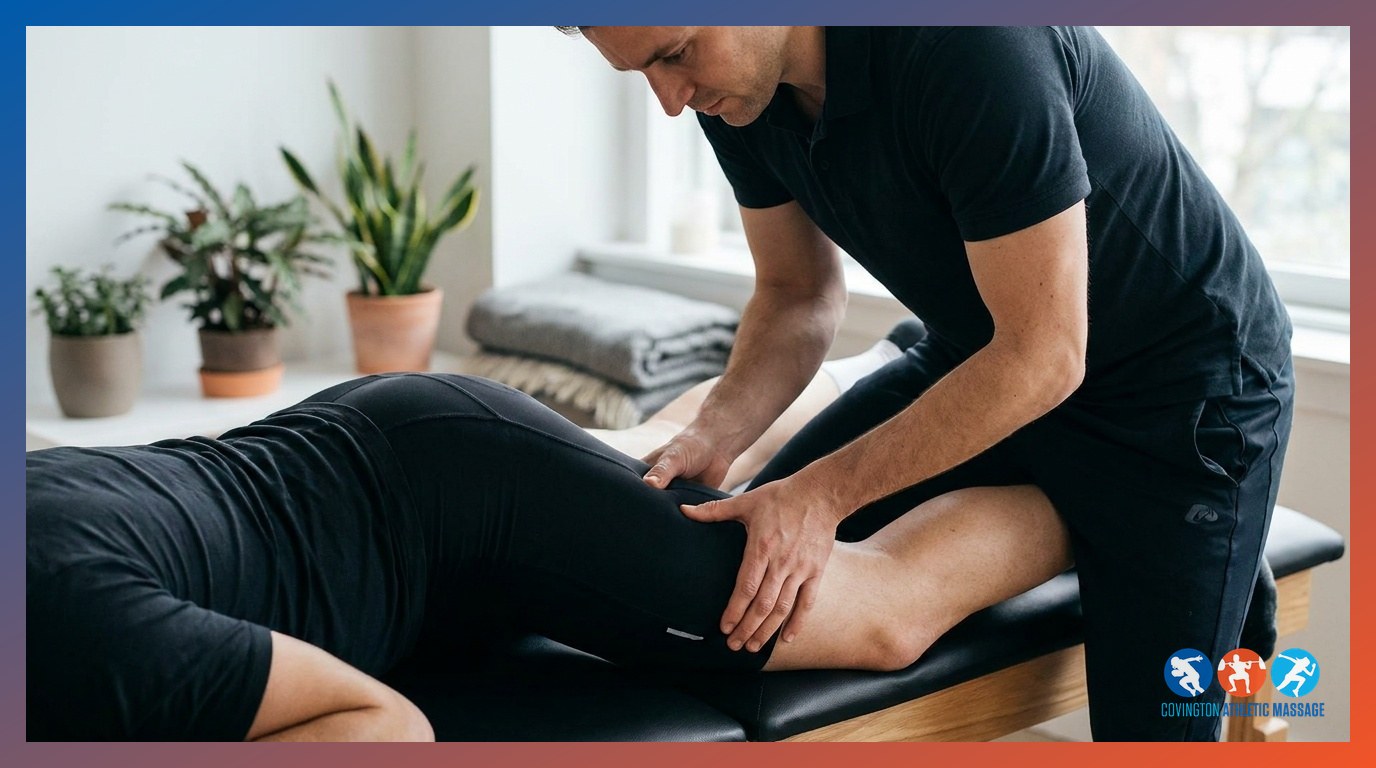
IT band syndrome is caused by tension in the TFL and hip abductor complex that transmits load to the lateral knee via the iliotibial band. That band is non-contractile fascia; the band cannot tighten or release on its own. A 2024 Physician and Sportsmedicine analysis ties hip abductor weakness and lateral hip tension to IT band syndrome history in distance runners.
That anatomy sets the target. Condition-specific sports massage never treats the named condition; it treats the muscles and fascia whose tension produces the symptoms. The condition-specific injury massage for lateral knee pain works slow deep tissue strokes through the TFL, gluteus medius, and lateral quad and leaves the band alone, because the band contains no contractile tissue.
The Journal of Orthopaedic & Sports Physical Therapy reported in 2014 that IT band syndrome affects 5% to 14% of runners and ranks as the leading cause of lateral knee pain in that group. A 2024 Frontiers in Sports and Active Living review places it near 10% of all running injuries, and the Journal of Athletic Training reported in 2021 that up to 24% of road cyclists develop it.
IT band syndrome becomes a recurring barrier to training when rest quiets the knee but the hip tension remains: the same lateral pain returns within weeks each time mileage or cycling volume climbs. Rest alone rarely changes that.
Shin splint care follows the same logic, targeting the tibialis posterior, flexor digitorum longus, and deep posterior compartment rather than the tibia itself; the Shin Splints and Lower Leg Pain sub-page covers that compartment tightness apart from IT band and plantar conditions.
Covington Athletic Massage books IT band and lateral knee pain sessions for runners and cyclists in Covington, Georgia.
Does sports massage help with plantar fasciitis and heel pain?
Yes. Sports massage helps with plantar fasciitis and heel pain by releasing tension in the calf muscles that load the plantar fascia, which reduces the strain the fascia absorbs with every step and every push-off.
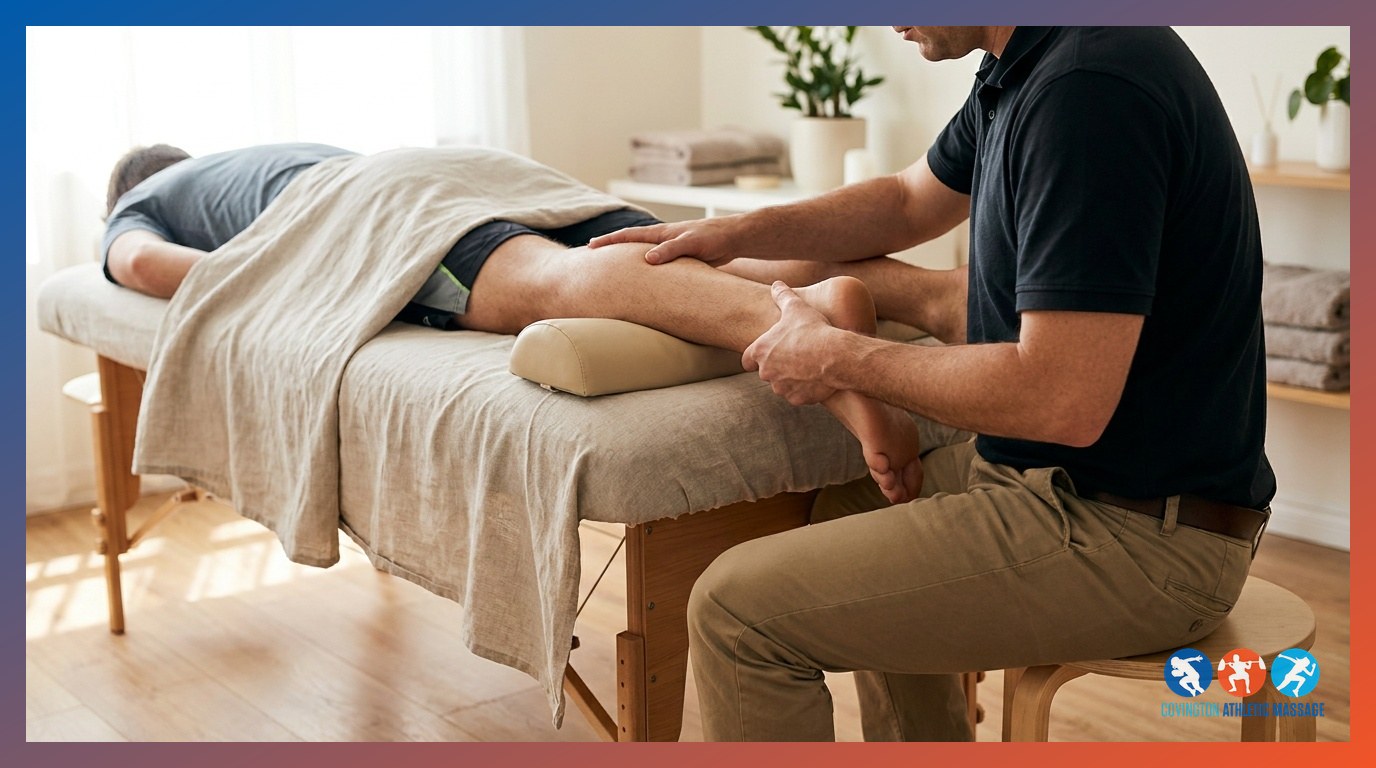
Plantar fasciitis is a load-distribution problem, and plantar fasciitis has a proximal soft-tissue component in the gastrocnemius and soleus that deep tissue massage can directly release. Medscape’s 2024 clinical reference lists tightness in the gastrocnemius, soleus, and Achilles tendon, along with reduced ankle dorsiflexion and weakness of those muscles, as recognized risk factors for plantar fasciitis. A 2022 study published in Cureus found that weakness of the gastrocnemius, soleus, and intrinsic foot muscles predicted plantar fasciitis with an odds ratio of 7.39.
The tension chain runs downward. Tight calves load the Achilles tendon, and because the Achilles and plantar fascia share an attachment at the heel bone, calf tension reaches the fascia during push-off. Deep tissue release of the calf reduces the tension transferred through the Achilles and plantar fascia with each stride. Massage that works only on the foot commonly under-delivers; releasing the soleus and deep posterior compartment addresses the proximal tension chain that actually loads the fascia. ClinicalTrials.gov lists a trial registered in 2025 that is examining gastrocnemius tightness as a plantar fasciitis risk factor, with an estimated completion date of 2029.
Runners know this pattern best after a training change. Athletes returning from inactivity or sudden mileage increases load the calf and fascia faster than those tissues can adapt. Covington Athletic Massage includes plantar fasciitis care within its Pain Relief Therapy and Injury Care Massage services, and the condition-specific pain relief therapy explains how treatment pairs calf release with direct plantar soft-tissue work.
What shoulder and upper-body conditions can sports massage address?
Sports massage addresses rotator cuff pain, sub-acromial impingement, thoracic outlet syndrome, and the upper extremity nerve compression conditions behind arm numbness and weakness. Deep tissue work releases the supraspinatus, infraspinatus, scalenes, and pectoralis minor, reducing the muscular tension that drives shoulder symptoms in active people.
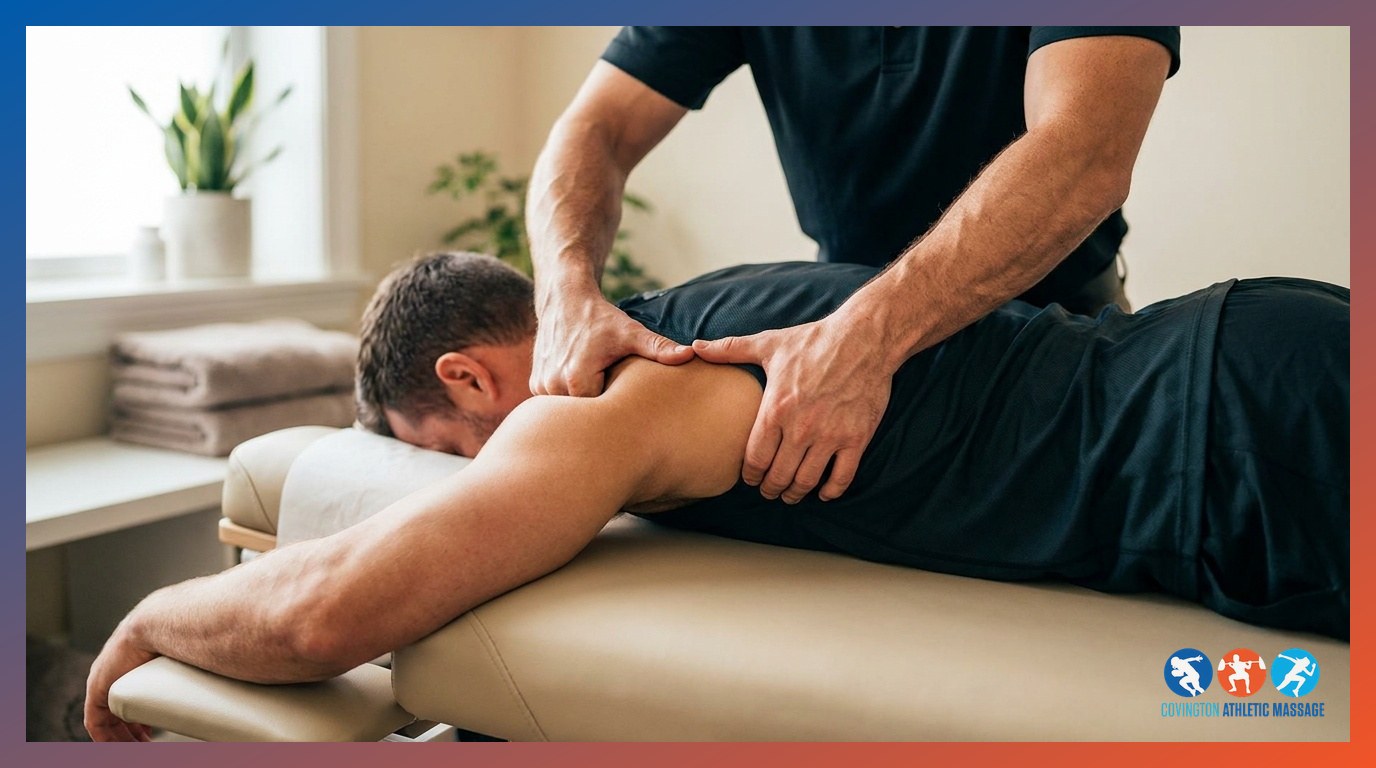
Rotator cuff pain is a condition involving muscular tension and impingement in the supraspinatus, infraspinatus, teres minor, and subscapularis that soft-tissue therapy can reduce. With sub-acromial impingement, tension in the supraspinatus and infraspinatus narrows the space beneath the acromion, and targeted deep tissue work on those two muscles restores tendon glide. Shoulder complaints rarely travel alone. Athletes who present with rotator cuff pain frequently also carry forward-head posture and upper thoracic stiffness, so a full-session protocol addresses the thoracic spine and pectoralis minor alongside the rotator group.
Thoracic outlet syndrome applies to overhead athletes, swimmers, and cyclists whose scalene and pectoralis minor tension compresses neurovascular structures passing between the neck and arm. Releasing the scalenes and pectoralis minor opens that outlet, and Thoracic Outlet Syndrome and Upper Extremity Pain details the assessment and release sequence for these presentations. Injury Care Massage sessions at Covington Athletic Massage address both rotator cuff and thoracic outlet cases, with each plan built around the athlete’s sport and training load.
How do I know if condition-specific sports massage at Covington Athletic Massage is right for me?
Condition-specific sports massage at Covington Athletic Massage is right for you if you are an athlete or active adult with a named or suspected soft-tissue condition, chronic or recurring pain, or a diagnosis you want to manage without surgery.
Runners, cyclists, overhead athletes, and active adults in Covington, Georgia use Covington Athletic Massage for condition-specific soft-tissue treatment. If you are weighing whether sports massage for specific conditions fits your situation, three checks will give you a clear answer.
1. Match your profile. You are a strong candidate if a clinician has named your condition, if you suspect a muscle, tendon, or fascia problem, if pain keeps returning despite rest, or if you want non-surgical support alongside a diagnosis you have already received. 2. Know what the first session covers. Your therapist starts with an intake, talks through your condition history and goals, then selects a targeted protocol for the tissue involved. Some conditions respond better to sustained pressure work, and Deep Tissue Massage in Covington, GA covers that approach. 3. Book with specifics. When you schedule condition-specific sports massage Covington, state your diagnosis or suspected condition, where the pain sits, how long it has been present, and what training you are currently doing. Those details let the clinic match you with the right therapist and protocol before you walk in, so your first visit starts treating rather than guessing.
Sources
- Sports (MDPI), “Prevalence and Clinical Patterns of Piriformis Syndrome Among Actively Competing and Retired Elite Hockey Players” (2026)
- Physiopedia, “Medial Tibial Stress Syndrome” (2024)
- Frontiers in Sports and Active Living, “Effects of Conservative Treatment Strategies for Iliotibial Band Syndrome on Pain and Function in Runners: A Systematic Review” (2024)