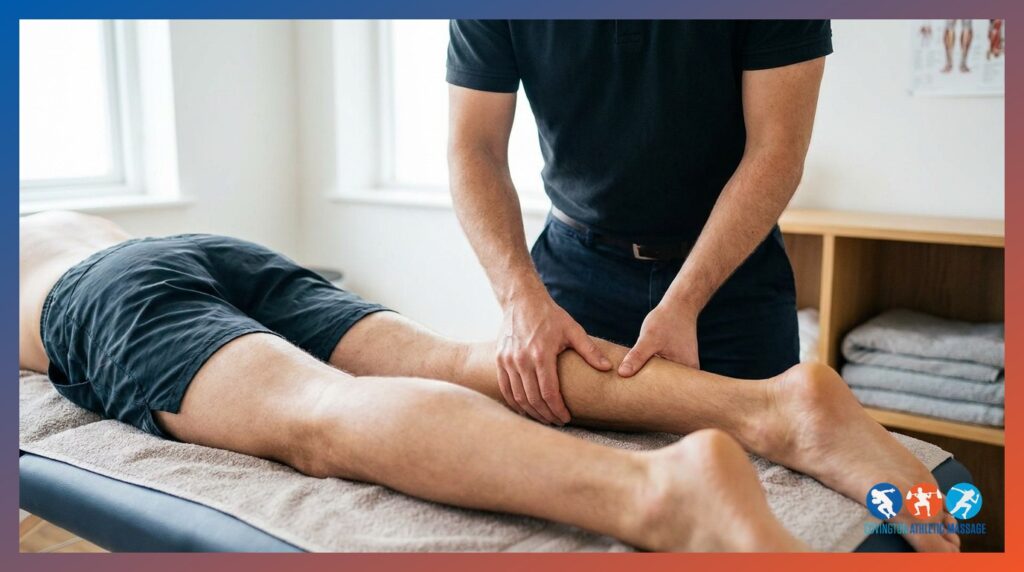
Injury Care massage treats tendinitis at its mechanical root, the tendon tissue breakdown that repetitive athletic loading causes faster than the body can repair. Sports massage techniques such as deep tissue work and cross-fiber friction restore damaged tendon tissue in ways that rest alone cannot. Athletic Deep Tissue Massage Clinic in Covington, Georgia structures Injury Care sessions to reduce tendon pain and return athletes to training without the re-injury cycle that untreated tendinitis produces.
What is tendinitis and why do athletes keep getting it?
Tendinitis is inflammation of a tendon caused by repetitive mechanical overload that outpaces the tendon tissue’s capacity to repair itself. Athletes keep getting tendinitis because training volume spikes, inadequate recovery, and muscle imbalances repeatedly overload the same tendons.
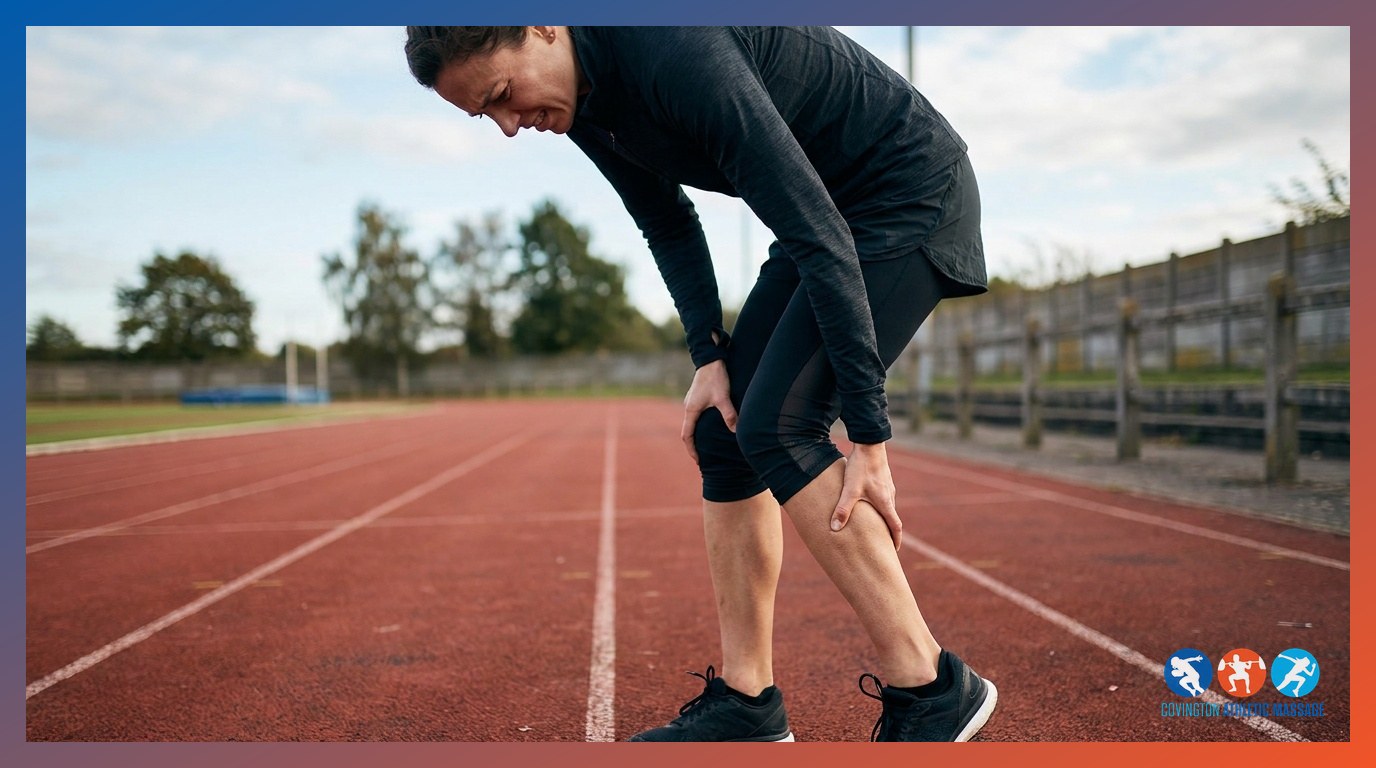
Tendinitis develops gradually rather than from one bad step or throw. Every training session creates microscopic damage in tendon fibers, and a healthy tendon repairs that damage between sessions. When daily load exceeds the tissue’s repair rate, fibers break down faster than the body can rebuild them, and the tendon becomes inflamed, painful, and stiff. Because this damage accumulates quietly before sharp pain appears, clinicians describe tendinopathy as the silent epidemic of athletic overuse.
Athletes face disproportionate risk because sport concentrates repetitive load on a small set of tendons. Training volume spikes, such as a sudden jump in weekly mileage or throwing intensity, give tendons more load than their current capacity handles. Inadequate recovery shortens the repair window between sessions, and muscle imbalances shift extra strain onto the tendon when a weak or tight muscle group fails to absorb its share of force. According to a 2025 ScienceDirect study of high-performance athletes, 30.6% had a confirmed tendinopathy diagnosis, with prevalence rising to 36.5% among athletes with the highest training exposure index compared to 21.9% among athletes with low training exposure.
The same four sites account for most athletic tendinitis:
- Achilles tendon: runners and court-sport athletes who sprint, cut, and push off thousands of times per practice.
- Patellar tendon: jump athletes in basketball and volleyball, where repeated explosive extension overloads the tendon below the kneecap.
- Lateral elbow (tennis elbow): racket and throwing athletes who load the wrist extensors with every stroke or pitch.
- Rotator cuff: overhead athletes such as swimmers, pitchers, and tennis servers whose shoulders repeat high-velocity motion.
Rest alone rarely fixes tendinitis. Rest reduces pain by removing the aggravating load, but rest does not resolve adhesions or correct the degraded tissue quality that made the tendon vulnerable, so symptoms return when training resumes. A 2020 ScienceDirect study found that prior Achilles tendinopathy within the preceding 12 months is the strongest risk factor for recurrent Achilles symptoms, which is why understanding what causes tendinitis to recur matters more than waiting for pain to fade. Soft-tissue intervention targets those adhesions and tissue-quality deficits directly, and the right manual approach depends on whether a tendon presents as acute tendinitis versus chronic tendinosis, since each state responds to different treatment.
Which tendinitis conditions does the clinic treat with massage?
The clinic treats four tendinitis presentations with sports massage: Achilles tendinitis, patellar tendinitis (jumper’s knee), tennis elbow (lateral epicondylitis), and rotator cuff tendinitis. Treatment pairs each tendon with condition-specific manual techniques.
Achilles tendinitis appears most often in runners and court athletes. Massage addresses the gastrocnemius-soleus complex and the Achilles insertion, and because Achilles tendinitis massage requires avoidance of direct aggressive pressure on an acutely inflamed tendon, work starts proximal on the calf complex. Insertional Achilles tendinitis is treated differently than mid-portion Achilles tendinitis because direct compression at the calcaneal attachment is contraindicated in insertional cases. The massage for Achilles tendon pain details that sequencing, and the lower-limb joint pain massage covers related ankle and knee work.
Patellar tendinitis, or jumper’s knee, affects basketball, volleyball, and track athletes, and a 2023 PubMed review found volleyball and basketball players carry the highest prevalence. Massage addresses the entire quadriceps-patellar chain, including the vastus lateralis and rectus femoris, not just the tendon itself, because excessive quad tension is the primary upstream driver of patellar tendon load in jump athletes. The massage therapy for jumper’s knee explains how the clinic unloads that chain.
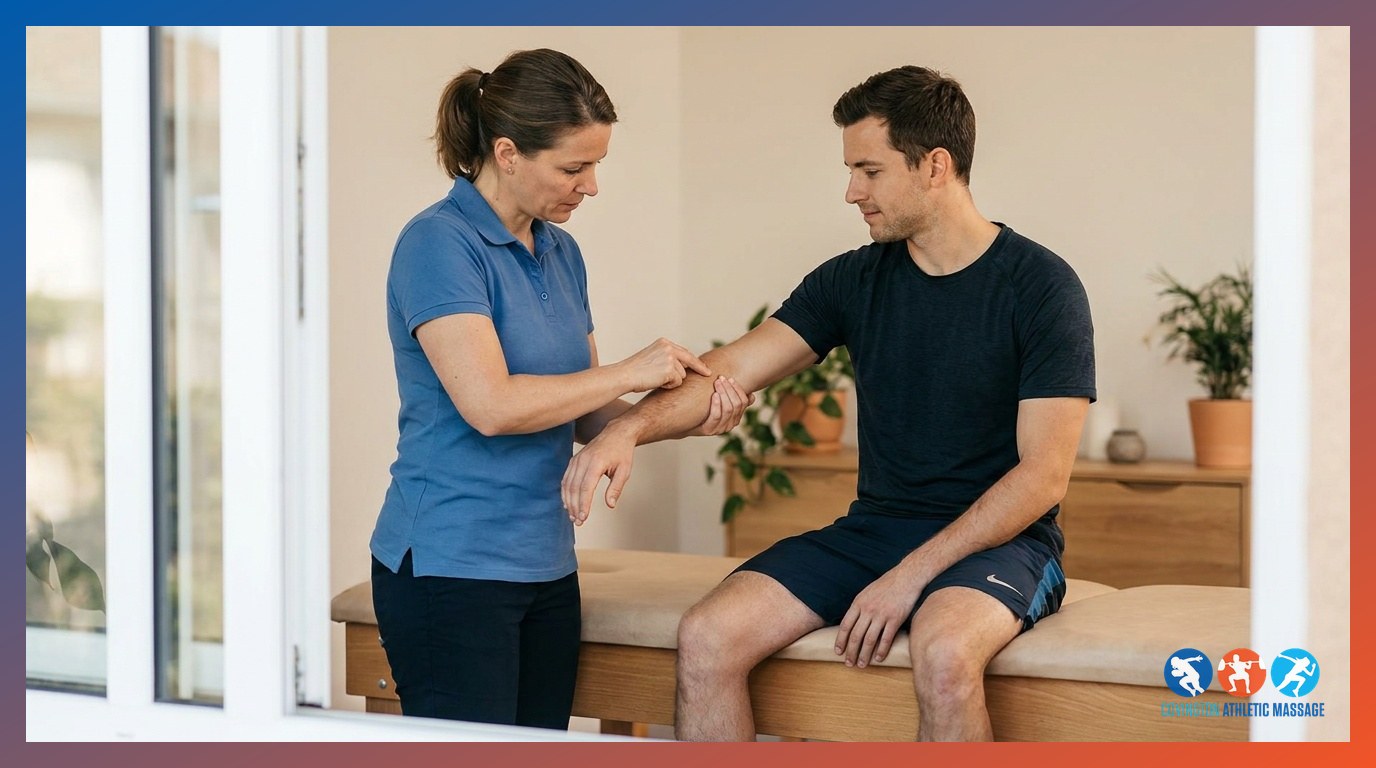
Tennis elbow (lateral epicondylitis) affects racket-sport athletes and throwers, and cross-fiber friction targets the extensor tendon origin at the lateral epicondyle. The condition also appears in rowers, climbers, and baseball pitchers, so the name is not a reliable indicator of sport context; according to ClinicalTrials.gov (2019), tennis players account for only 5% of lateral epicondyle tendinopathy cases seen in clinical practice.
Rotator cuff tendinitis affects overhead athletes including baseball players, swimmers, and volleyball athletes. Massage addresses the supraspinatus and infraspinatus muscle-tendon units, an approach the treating rotator cuff tendinitis with massage describes in full.
How does massage treat tendinitis — what techniques are used and why?
Massage treats tendinitis with two sequenced techniques. Deep tissue massage releases the overloaded muscle belly that pulls on the inflamed tendon, and cross-fiber friction then breaks down adhesions inside the tendon, applied perpendicular to the fiber alignment once acute inflammation subsides.
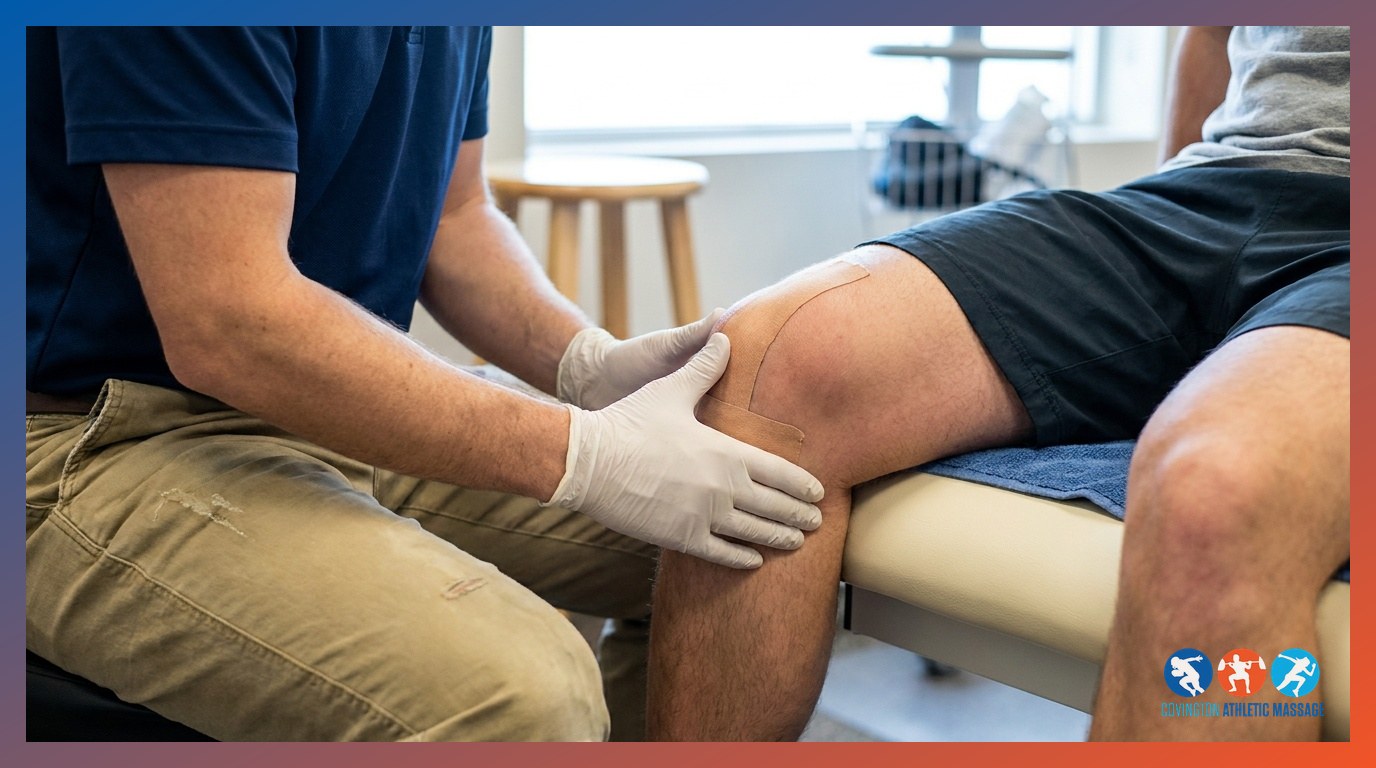
The tendon itself is not the first target. Deep tissue massage targets overloaded muscle bellies that transmit excessive tensile load to the inflamed tendon with every contraction. Releasing that proximal tension lowers the mechanical stress at the insertion site, which is what allows the irritated tendon to settle. Working directly on a hot, swollen tendon first is a common clinical error, and it typically worsens the presentation.
Sequence is everything here. The full treatment runs in a fixed order:
1. Assess the stage of the condition. Tendinitis vs. tendinosis determines which massage technique and pressure level is appropriate: acute inflammation requires gentler proximal work, while chronic degeneration tolerates deeper friction. 2. Release the proximal muscle belly with deep tissue work. Slow, specific pressure through the muscle reduces tensile overload at the insertion before any tendon-direct work begins. 3. Apply cross-fiber friction only after acute inflammation subsides. Cross-fiber friction massage is applied to tendon adhesions perpendicular to fiber alignment to restore tissue mobility. United States Patent and Trademark Office documentation describes this transverse application across tendon, ligament, and muscle fibers as a method for breaking down and preventing fibrous adhesions, and a 2012 review indexed on PubMed reports that deep friction massage may stimulate tendon healing by promoting fibroblast activity and increasing collagen type III production. The cross-fiber friction technique explained documents that mechanism in full depth. 4. Support the loading program rather than replace it. According to a 2019 ScienceDirect review, evidence favors a slowly progressive loading program over complete rest for tendinopathy, with massage serving mainly as a pain-relief adjunct alongside it.
Timing decides whether friction helps or harms. Applied to a hot, swollen tendon, cross-fiber work worsens irritation instead of restoring fiber alignment, which is why step three never moves ahead of step one.
One honest heads-up about the table: cross-fiber friction is intentionally uncomfortable, and the sensation differs from the steady pressure of deep tissue work. Your therapist should explain that difference before application, because technique-appropriate discomfort feels alarming if nobody warns you it is coming.
Tendinitis care also assumes overloaded but intact fibers. treating torn muscle fibers professionally follows a different protocol, because disrupted fibers need protection during early healing before they can tolerate friction or deep pressure.
What does an Injury Care session for tendinitis look like at the clinic?
An Injury Care session for tendinitis follows a structured sequence: intake assessment, proximal muscle work, tendon-specific technique, and mobility integration. The therapist identifies the irritated tendon, releases the muscles loading that tendon, applies targeted friction when appropriate, and closes with range-of-motion work.
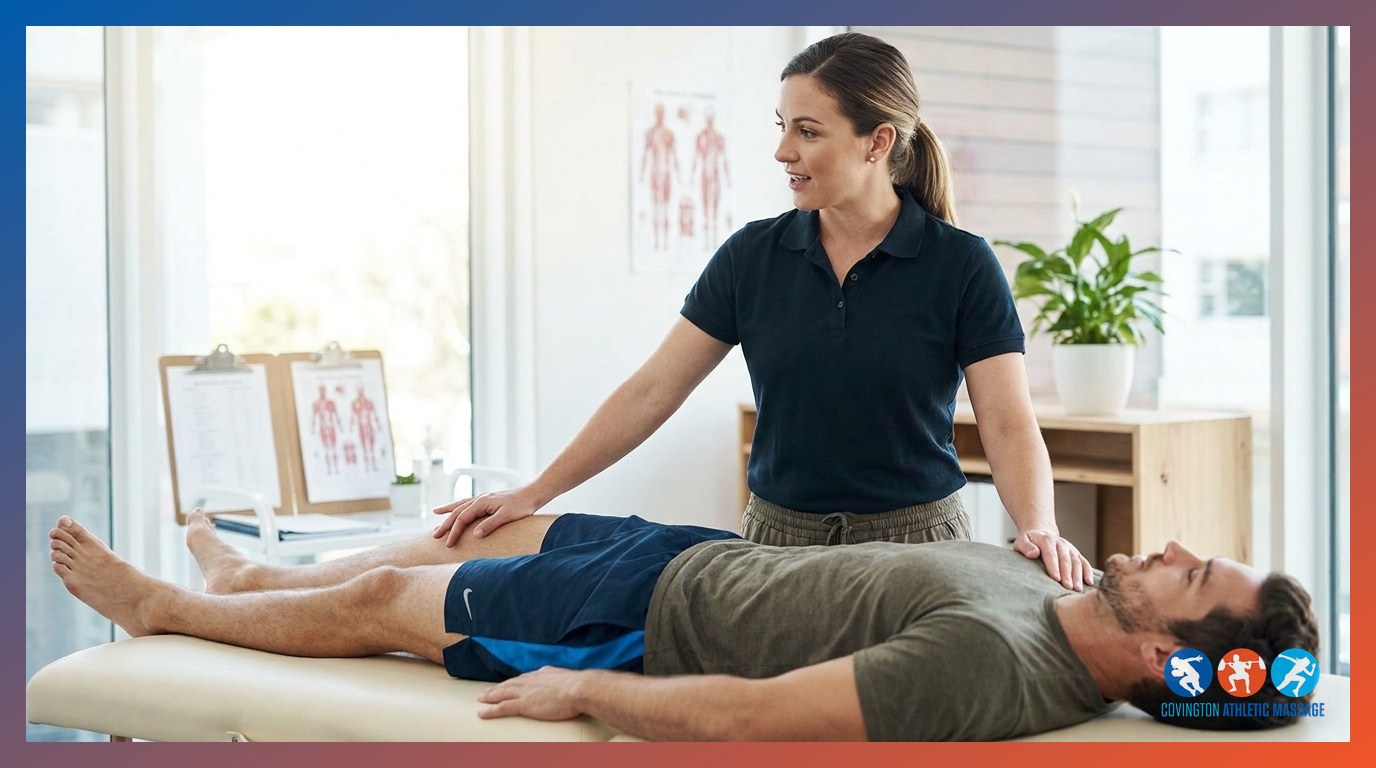
Every session opens with an intake assessment before any hands-on work begins. The therapist locates the affected tendon site, gauges the current inflammation level, and asks about training context such as recent mileage, practice schedules, and upcoming competition dates. Those answers determine which techniques are safe to apply that day.
The hands-on work proceeds in order. The therapist first releases the proximal muscles, such as the calf complex for Achilles tendinitis or the quadriceps for patellar tendinitis. The therapist then treats the soft tissue adjacent to the tendon, applies cross-fiber friction directly to the tendon when the inflammation level permits, and finishes with range-of-motion integration so the joint moves normally again.
Athletes typically feel firm, focused pressure during friction work and localized soreness afterward. That soreness is a normal response and settles within a day or two. A significant symptom flare after a session signals the technique was premature, and the therapist adjusts the plan for the next visit.
Most tendinitis presentations require multiple sessions rather than a single visit. The tendinitis massage treatment timeline explains how session counts vary by tendon and by how long the condition has been present. The tendinitis-focused massage care page covers booking and session pricing for Injury Care at the Covington clinic.
Sources
- ScienceDirect, “Implications of tendinopathy on the sports career: Epidemiological and clinical profile of high-performance athletes” (2025)
- ScienceDirect, “Epidemiology of insertional and midportion Achilles tendinopathy in runners: A prospective cohort study” (2023)
- ScienceDirect, “Incidence of Achilles tendinopathy and associated risk factors in recreational runners: A large prospective cohort study” (2020)
- ScienceDirect, “Current trends in tendinopathy management” (2019)