
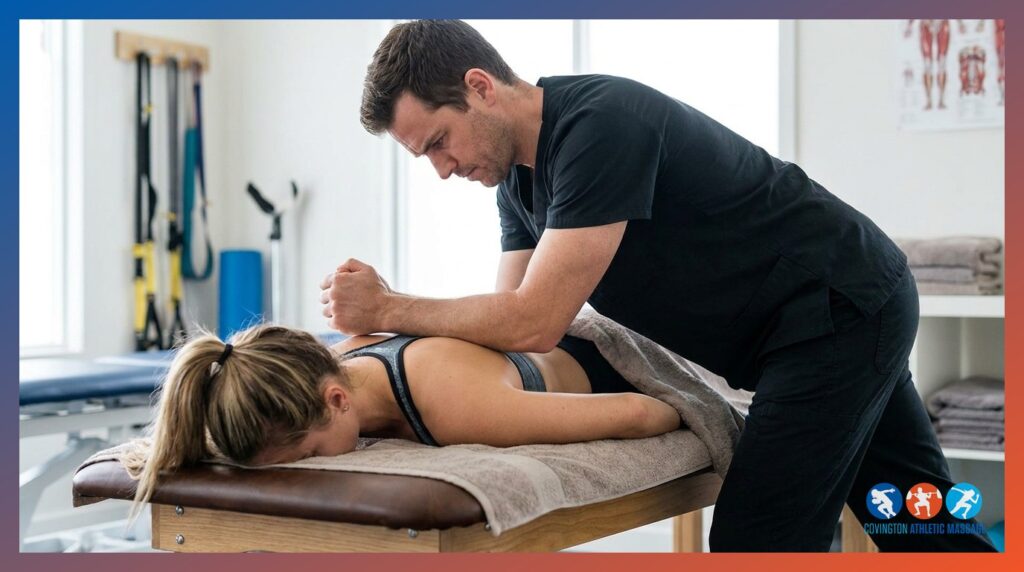
Deep tissue massage is a manual therapy modality that applies slow, sustained pressure to reach the myofascial layers and deep muscle tissue that lighter techniques cannot affect. Deep tissue massage differs from Swedish massage in structure and purpose: rather than simply pressing harder, deep tissue massage uses specific strokes to release chronic tension patterns and restricted fascia. Athletes in Covington, Georgia rely on deep tissue massage to manage pain, recover from soft-tissue injury, and restore restricted movement.
What is deep tissue massage and how is it different from other types of massage?
Deep tissue massage targets suboccipital, fascial, and deep muscular layers beneath the superficial musculature through slow strokes and sustained pressure applied with thumbs, knuckles, and forearms. Deep tissue massage is distinct from Swedish massage in pressure depth, stroke speed, and therapeutic intent.

According to the National Center for Biotechnology Information (2025), deep tissue massage belongs to the group of therapeutic methods described as soft tissue manipulation, defined as the manual action of a therapist in the superficial and deep layers of muscles and fascia to relax tissue, change abnormal patterns, and eliminate tension and pain. That definition names the territory. Deep tissue massage earns the “deep” label because the modality works past surface muscle into the fascia and deeper layers where chronic problems actually live.
The mechanical differences between deep tissue massage and Swedish massage fall into four categories:
- Stroke rate. Deep tissue massage moves slowly, giving fascial tissue time to deform and release, while Swedish massage uses a faster, rhythmic pace designed for circulation and relaxation.
- Stroke direction. Deep tissue work applies cross-fiber and longitudinal strokes across or along specific muscle fibers, while Swedish massage relies on long effleurage strokes that follow venous return.
- Working surface. Thumbs, knuckles, elbows, and forearms create a small contact area that concentrates force into deep layers instead of spreading force across skin and surface muscle.
- Pressure calibration. The therapist scales pressure to the depth of the tissue being treated, not to relaxation comfort.
Because of those mechanics, “deep tissue” names a modality category, not a pressure setting on a relaxation massage. More pressure without changed mechanics does not constitute deep tissue work. Pressing harder with Swedish effleurage produces soreness without the fascial change and trigger point effects that define deep tissue outcomes, which is why a firm Swedish session and a true deep tissue session feel different and resolve different problems.
Within the broader manual therapy landscape, deep tissue massage functions as a parent category with distinct neighbors. Sports massage borrows deep tissue strokes and applies them to athletic preparation and recovery. Myofascial release shares the fascial target but uses gentler sustained holds. Trigger point therapy adopts deep tissue pressure to deactivate hyperirritable knots. The deep tissue massage Covington practice draws on sports massage, myofascial release, and trigger point therapy together when building treatment plans for local athletes.
Deep tissue massage is designed for three specific tissue problems:
- Chronic tension patterns: long-held shortening in postural muscles that relaxation massage does not reach.
- Fascial adhesions: stuck fascial layers that restrict glide between muscles.
- Hyperirritable trigger points: focal knots that refer pain elsewhere and resist light pressure.
What techniques do deep tissue massage therapists use?
Stripping, cross-fiber friction, pin-and-stretch, and active release are the core techniques of deep tissue massage practice. Each technique applies slow, sustained pressure to reach deep muscular and fascial layers that lighter massage strokes cannot affect.
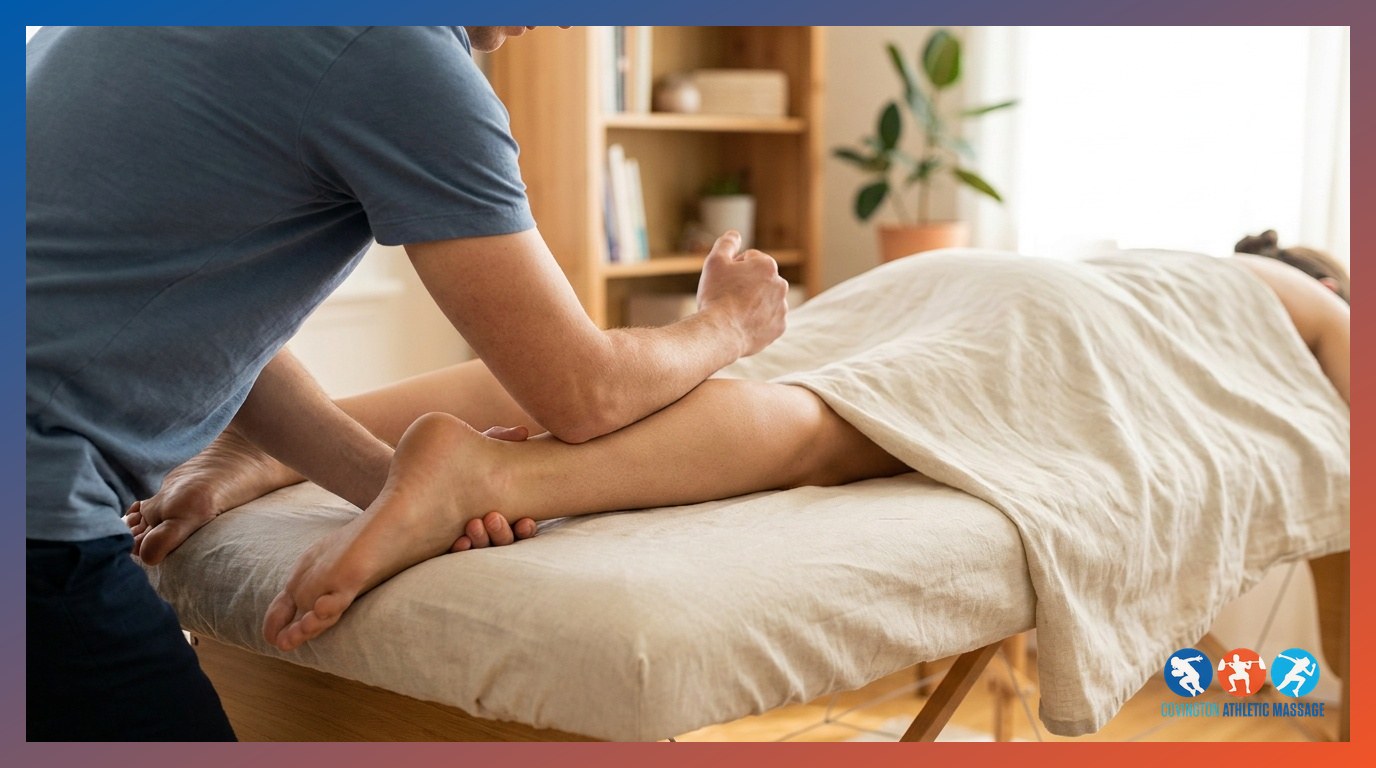
The core techniques behind deep tissue therapy share one mechanical principle: pressure must stay slow and specific enough to change tissue rather than simply compress it. Four strokes accomplish that.
Stripping uses slow, longitudinal gliding along the muscle belly with sustained pressure. The stroke elongates restricted muscle fibers, which makes stripping the standard choice for tight hamstrings, calves, and the muscles running alongside the spine.
Cross-fiber friction applies transverse strokes perpendicular to the muscle or tendon fibers. The technique breaks adhesions between fibers and stimulates collagen remodeling, so therapists use friction where tissue has healed in a disorganized pattern after strain or overuse. A 2025 systematic review of 12 studies published in BMC Musculoskeletal Disorders assessed the effect of friction massage on pain intensity, pressure pain threshold, and joint range of motion in individuals with myofascial trigger points.
Pin-and-stretch anchors a shortened muscle at one point while the limb moves through its range of motion. The anchored pressure holds the fiber under load as the limb lengthens, restoring fiber length that static pressure alone does not reach.
Active release and compression techniques pair sustained pressure with movement directed by either the therapist or the client. That combination addresses restrictions that only appear during motion, which matters for athletes whose pain shows up mid-stride or mid-swing rather than on the table.
On large muscle groups such as the glutes, erector spinae, and hamstrings, therapists substitute the forearm or elbow for thumbs. The broader contact surface sustains deep pressure without therapist fatigue, so the final minutes of a long session carry the same force as the first.
How does deep tissue massage actually work on the body?
Deep tissue massage works through three linked mechanisms: sustained pressure softens fascial tissue and releases adhesions, direct compression deactivates myofascial trigger points, and mechanoreceptor stimulation lowers resting muscle tone through the nervous system. Mild soreness for 24 to 48 hours afterward is normal.
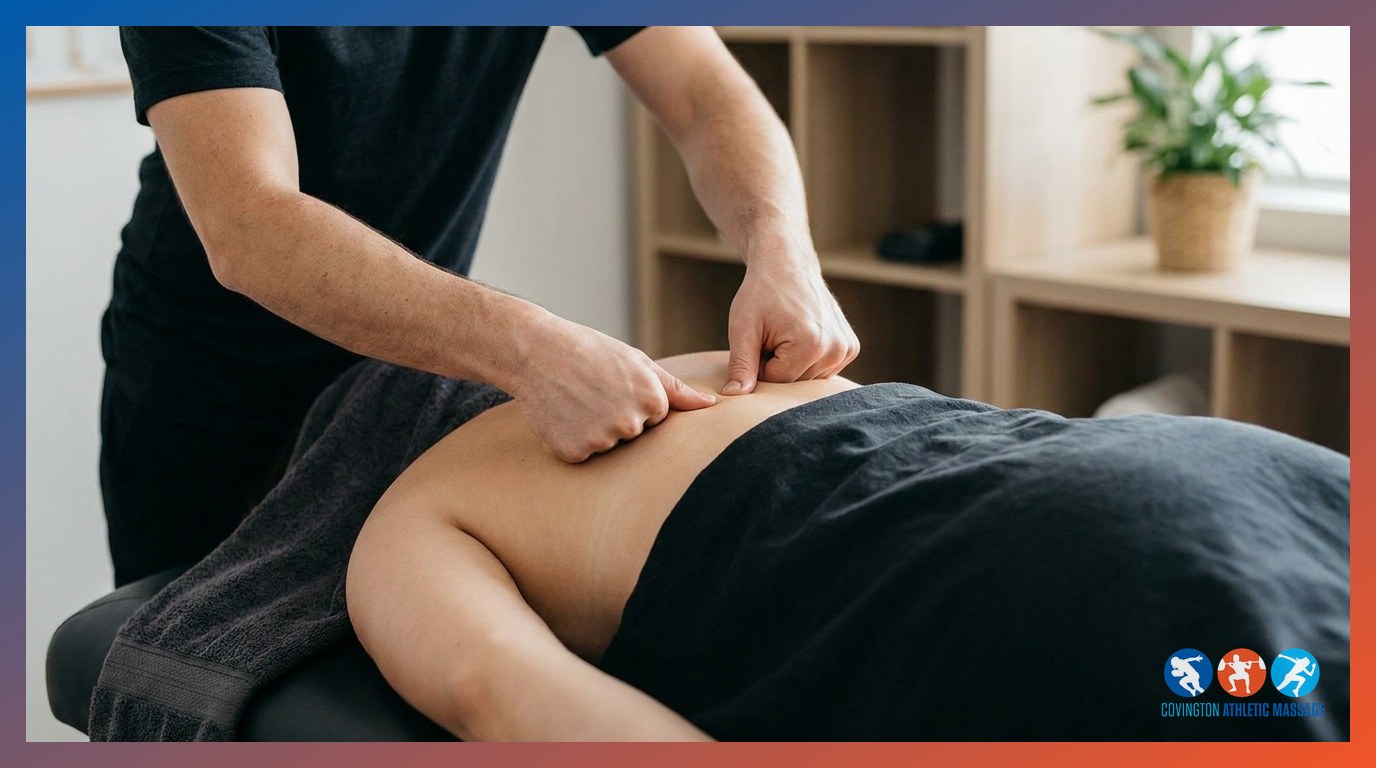
1. Fascial release. Fascial adhesions are broken down by the slow, compressive strokes of deep tissue massage. Sustained compressive and shear forces alter the viscosity of fascial ground substance, letting restricted layers glide again. A 2026 Frontiers in Physiology review of the physiological basis of deep tissue work credits viscoelastic deformation and structural remodeling with reducing tissue stiffness and improving inter-layer glide. A 2023 Jagiellonian University Medical College study confirms that deep palpation aimed at releasing fascia restrictions reduces symptoms of fascial disorders.
2. Trigger point deactivation. Deep tissue massage deactivates myofascial trigger points by applying sustained pressure to hyperirritable muscle knots. Direct ischemic compression briefly restricts blood flow to the hyperirritable locus inside a taut band. The locus releases as pressure lifts, and fresh circulation returns to the tissue.
3. Neuromuscular reset. Deep pressure stimulates mechanoreceptors in fascia and muscle, which modulates nociceptive signaling and reduces sympathetic nervous system activity. The nervous system then lowers resting muscle tone, so the muscle stops guarding.
4. Post-session soreness. The ache after a session is a normal neurological and inflammatory response to loading previously restricted tissue, not a sign of injury or therapist error, and it typically resolves within 24 to 48 hours. A double-blinded randomized controlled trial published in The Journal of Pain in 2008 measured a 25% to 50% reduction in myalgia symptoms after massage, varying with assessment technique. Athletes who understand sports massage action and body response plan hard training outside that window; athletes who quit after one uncomfortable session miss the cumulative adaptation that repeated sessions build.
What conditions and athletic situations is deep tissue massage used for?
Deep tissue massage applies to chronic pain, muscle strains, tendinopathy, restricted mobility, and post-training soreness in athletes. Therapists choose deep tissue massage when the source of pain or stiffness lives in deep muscular and fascial layers rather than surface tissue.
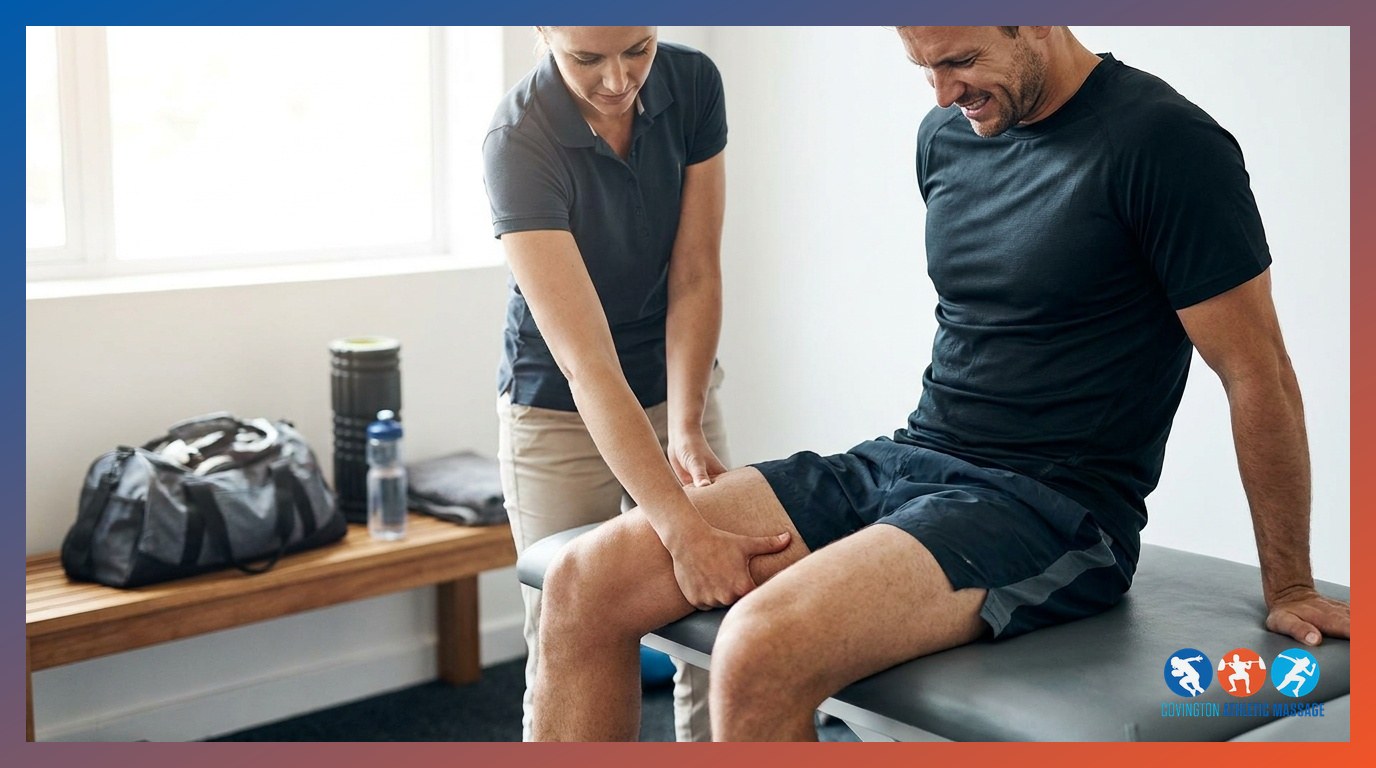
Chronic pain and postural tension respond to repeated sessions, because sustained slow pressure remodels chronically shortened tissue instead of producing only temporary relief. A 2023 randomized controlled trial in Somatosensory & Motor Research examined 80 patients with myofascial pain syndrome, with the study group receiving 12 deep tissue sessions in addition to standard electrotherapy, reflecting the cumulative dosing chronic conditions demand.
Muscle strains and tendinopathy call for a different technique than general tension work: therapists apply cross-fiber friction at the musculotendinous junction. Application is not uniform across conditions. Chronic postural tension responds to slow stripping along the muscle belly, while tendinopathy responds better to friction at the junction, and selecting the wrong technique for the tissue state weakens the outcome and can delay recovery.
For post-training soreness, deep tissue applied 24 to 48 hours after intense training accelerates metabolic waste clearance and reduces DOMS duration. Frontiers in Public Health (2025) reports that delayed onset muscle soreness develops within 12 to 24 hours, peaks at 24 to 72 hours, and usually resolves within 7 days, so a correctly timed session meets soreness at its peak.
Fascial adhesions restrict mobility by binding tissue layers together, forcing athletes into compensatory movement patterns that waste energy; deep tissue frees those layers and restores normal movement economy. A 2023 pilot study from Jagiellonian University Medical College (PMC / NCBI) found that vital capacity and oxygen saturation increased significantly only in the deep tissue group.
One caution for competitors: deep tissue immediately before competition is contraindicated, because the neuromuscular inhibition and temporary tissue soreness it produces impair explosive output, so pre-event work uses lighter, activating techniques instead. Choosing which treatment suits your condition depends on the tissue involved and the training calendar, and the athlete-focused sports massage reference covers session timing across a full training cycle.
Who should and shouldn’t get deep tissue massage?
Deep tissue massage suits athletes managing chronic muscle tension, a soft-tissue injury history, restricted movement, or high training loads. Deep tissue massage is unsafe for athletes with active inflammation, open wounds, acute fractures, blood clots, or active skin infections at the treatment site.
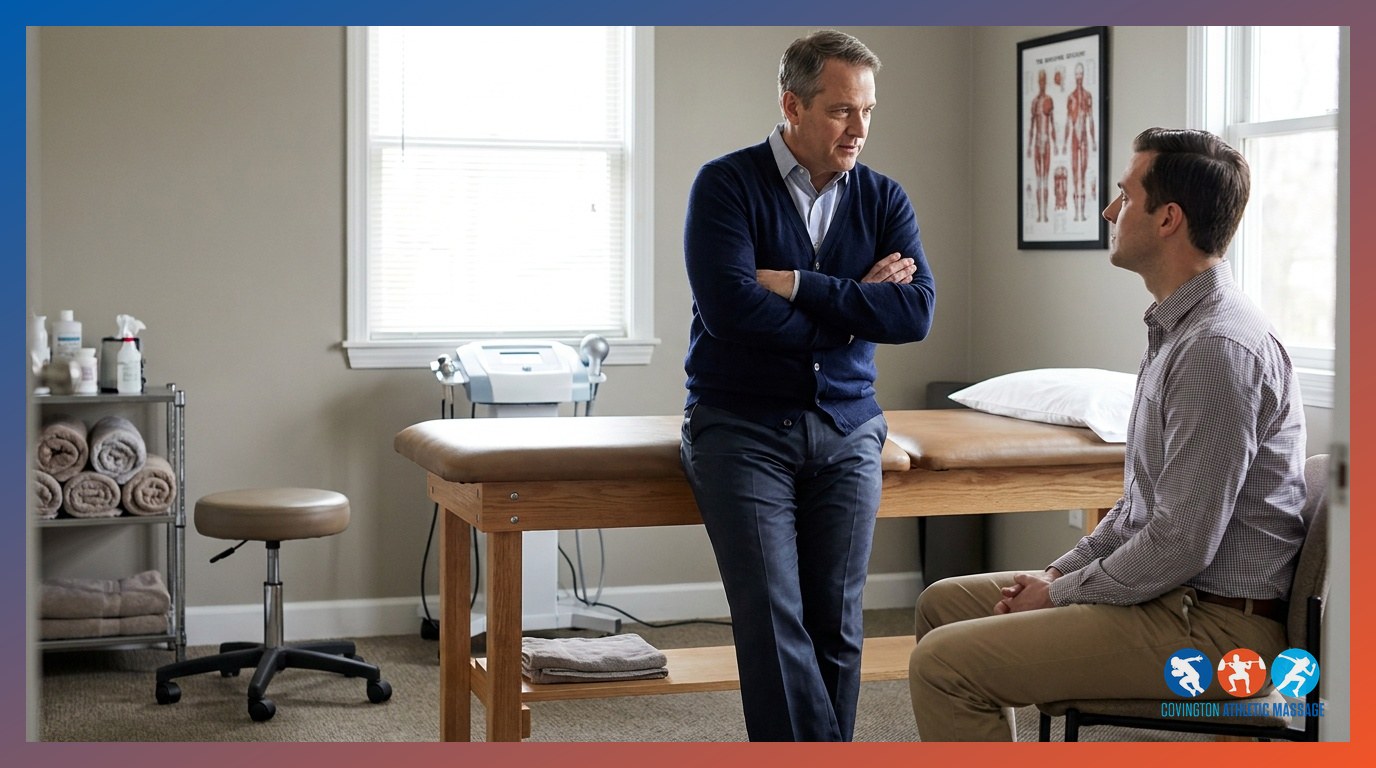
Absolute contraindications for deep tissue massage include active inflammation, open wounds, blood clots, and acute fracture sites. Deep pressure over a deep vein thrombosis can dislodge a clot, and heavy strokes over a fresh fracture or infected skin compound the damage. Athletes with any of these conditions must wait until the condition fully resolves before booking.
Modifiable contraindications lower the pressure ceiling rather than cancel the session. Athletes taking NSAIDs or anticoagulants are not automatically excluded from deep tissue massage, but heavy work under anticoagulation therapy carries a genuine bruising and hematoma risk, so the therapist must reduce pressure significantly. Older athletes with reduced tissue resilience and athletes in the acute phase of a new injury require the same adjustment. According to a 2025 review published through PMC / NCBI, deep tissue massage is a safe modality with a wide range of applications because therapists can modify the techniques to meet the needs of the patient. The deep tissue contraindications explained resource covers the full pressure-modification framework for these cases.
Some symptoms point beyond soft tissue. Numbness, radiating pain, or unexplained swelling suggests nerve involvement or another pathology, and athletes reporting these symptoms need a medical evaluation before any session. Pregnant athletes count as a modifiable case rather than an exclusion: deep tissue work for a pregnant athlete requires modified positioning and avoidance of specific acupressure points, and the athlete should discuss both with the treating therapist.
At Covington Athletic Massage in Covington, Georgia, deep tissue massage serves as the clinic’s primary therapeutic tool for athletes, and every new client completes a health screening before pressure decisions. Cleared athletes can review session formats through the local deep tissue booking options.