
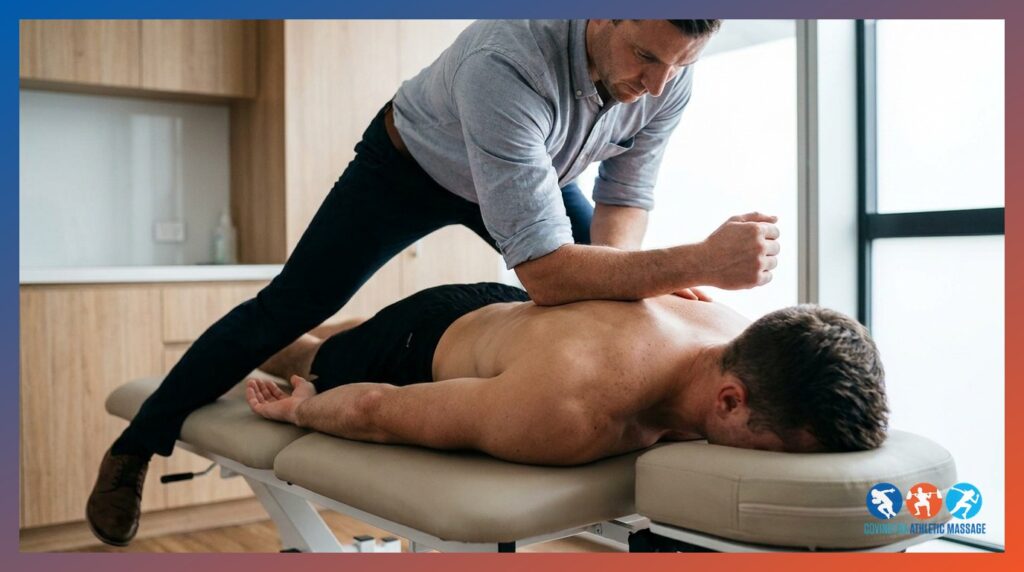
Deep tissue sports massage restores movement for athletes in Covington, Georgia who still feel stiff and restricted despite consistent training and stretching. Chronic stiffness in trained athletes usually signals soft-tissue dysfunction: fascial adhesions, deep muscular tension, and scar tissue left behind by old injuries. Covington Athletic Massage applies clinical deep tissue techniques to release those adhesions and return free, comfortable range of motion.
Why do athletes develop restricted movement and chronic stiffness even when they train regularly?
Athletes develop restricted range of motion through fascial adhesions from repetitive loading, mature scar tissue from old injuries, and chronic muscular tension the nervous system maintains, not through structural joint damage alone. Training creates the restriction, and training alone cannot release it.
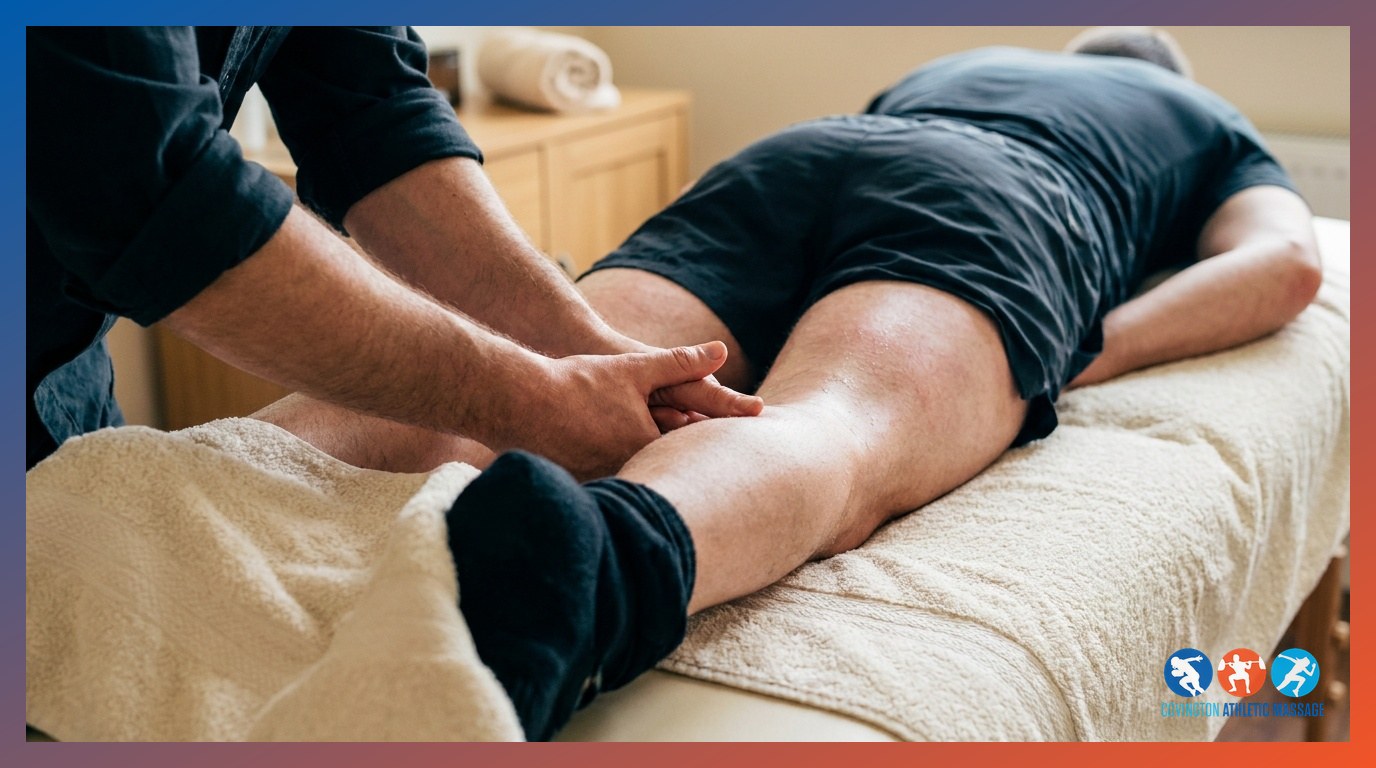
Fascial adhesions accumulate quietly. Each hard session loads the same connective tissue and leaves micro-trauma the body patches with fresh collagen. Dehydrated fascia loses the fluid glide between layers, so those patches bond surfaces that should slide across each other. A 2023 review from the National Library of Medicine’s PMC database reports that fascial tissue grows denser and more fibrotic with age, reducing joint range of motion in ways muscle loss alone cannot explain. Heavy training volume accelerates that timeline.
Scar tissue adds a second layer. After a strain, tear, or surgery, the body repairs the site with dense, cross-linked collagen that matures stiffer than the tissue it replaces. World Athletics reports that normal gliding between neighboring tissues is lost at these sites, leaving a constant low-grade inflammatory process, and that scar tissue has a poor blood supply and remains a likely site of re-injury. Every stride then tugs on a patch that does not stretch.
Chronic muscular tension adds a third. The nervous system reads overloaded or damaged tissue as a threat and recruits nearby muscles to guard it, and those protective holding patterns persist at rest, during sleep, and through the offseason. Guarding becomes the default setting. The athlete experiences that default as permanent tightness that rest days never touch.
Self-care stalls here for a specific reason. Stretching and foam rolling do not resolve deep fascial adhesions or cross-linked scar tissue, because those restrictions require sustained manual pressure to remodel. Stiffness that persists despite a faithful stretching routine is typically fascial rather than muscular in origin: fascia does not respond to passive elongation the way muscle fibers do, which is why stretching yields diminishing returns for athletes with true restrictions and why sustained manual pressure is a different intervention entirely. The relief strategies for persistent muscle tightness cover how manual techniques reach the tissue stretching cannot.
Restriction also compounds over time. An untreated adhesion recruits surrounding tissue into its pattern, so range of motion narrows season after season. What feels like a hip or shoulder joint problem frequently originates in the surrounding soft tissue rather than the joint capsule, and releasing the overlying fascial and muscular restrictions often restores motion without any joint-specific intervention. Morning stiffness that loosens with movement is a reliable indicator of fascial restriction rather than articular pathology: fascia stiffens during inactivity and turns pliable with warmth and load, the opposite pattern of most joint conditions.
How does deep tissue sports massage restore mobility and range of motion?
Deep tissue sports massage is applied to fascial adhesions and scar tissue to mechanically break down restrictions and restore movement patterns: sustained pressure separates adhered tissue layers, directional force realigns scar collagen, and fresh circulation restores the extensibility that stiff joints need.
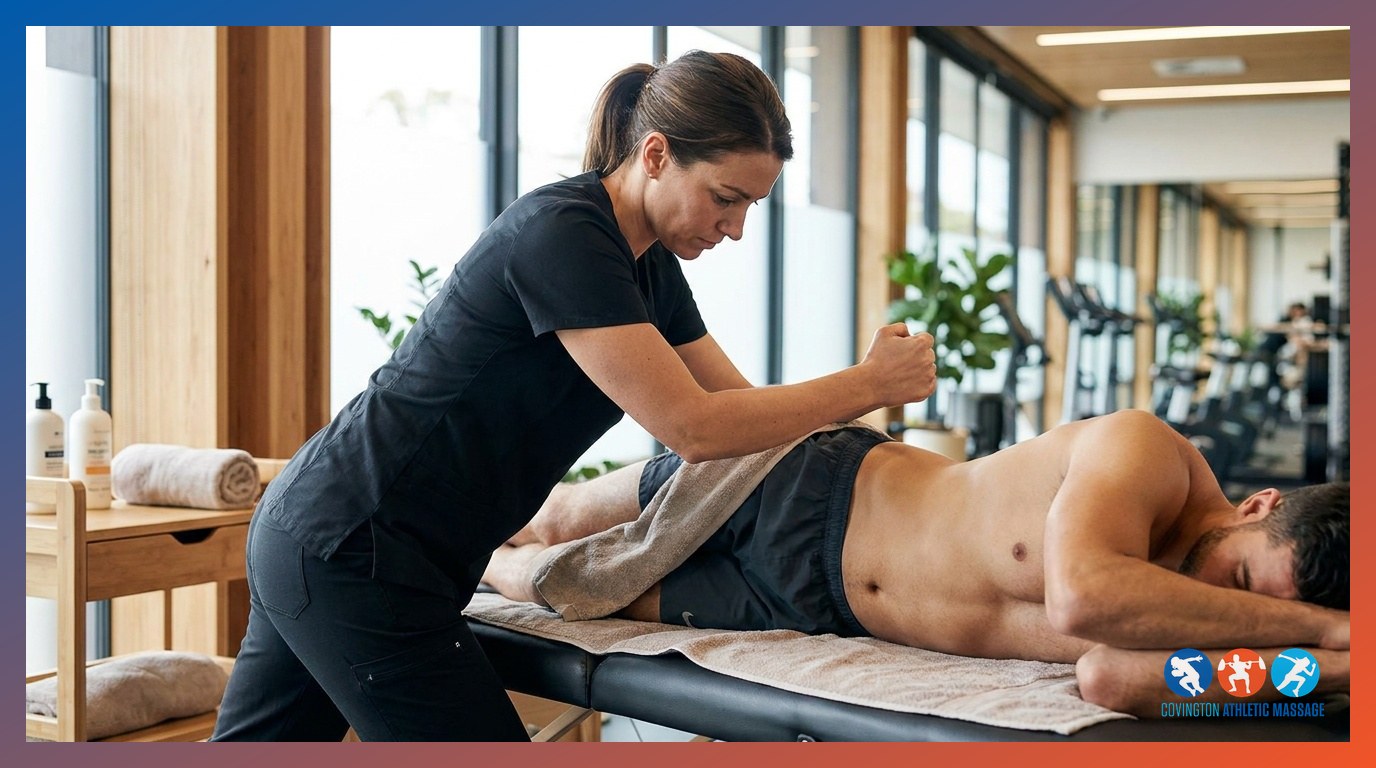
1. Adhesion disruption. Sustained manual pressure mechanically disrupts fascial adhesions and separates tissue layers that have lost independent glide. According to a 2026 Frontiers in Physiology review, sustained manual pressure deforms collagen and the extracellular matrix, breaking apart aberrant cross-links between fibers and restoring extensibility.
2. Scar tissue remodeling. Deep tissue work applies directional force that realigns cross-linked collagen fibers inside scar tissue. Scar tissue from a healed strain or tear does not disappear on its own: the tissue matures into dense, cross-linked collagen that permanently restricts glide between layers unless a therapist mechanically remodels the scar, so an athlete injured years ago can still carry an active mobility deficit from that event.
3. Myofascial release. Myofascial release is a manual therapy technique used within mobility restoration sessions to address fascial-layer restrictions that stretching alone cannot reach. The therapist applies slow, sustained holds to the fascial layer itself rather than using repetitive strokes. A 2026 Frontiers in Physiology review reports that myofascial release decreases motor neuron excitability and reduces EMG activity in resting muscle, which lowers the guarded tone that keeps tissue rigid.
4. Circulation and extensibility. Circulation completes the process. Deep tissue work increases local blood flow around treated tissue, and that fresh flow supports tissue extensibility while reducing the rigidity that limits joint movement.
The deep tissue approach to stiff joints explains how these four mechanisms work together in a single treatment plan. Athletes wondering whether massage measurably increases flexibility have direct trial evidence: a 2024 study indexed by the National Library of Medicine recorded a 14-degree acute increase in glenohumeral internal rotation and horizontal adduction in asymptomatic handball players after one Fascial Manipulation session, with 12-degree and 11-degree gains persisting one month later.
Which athletes and active adults benefit most from mobility restoration massage in Covington, GA?
Covington Athletic Massage serves athletes and active adults in Covington, Georgia experiencing stiffness, joint restriction, and limited movement from soft-tissue dysfunction. Four groups gain the most from mobility restoration massage: athletes with healed soft-tissue injuries, chronically tight trainers, competitors rebuilding range of motion, and recreational athletes over 35.
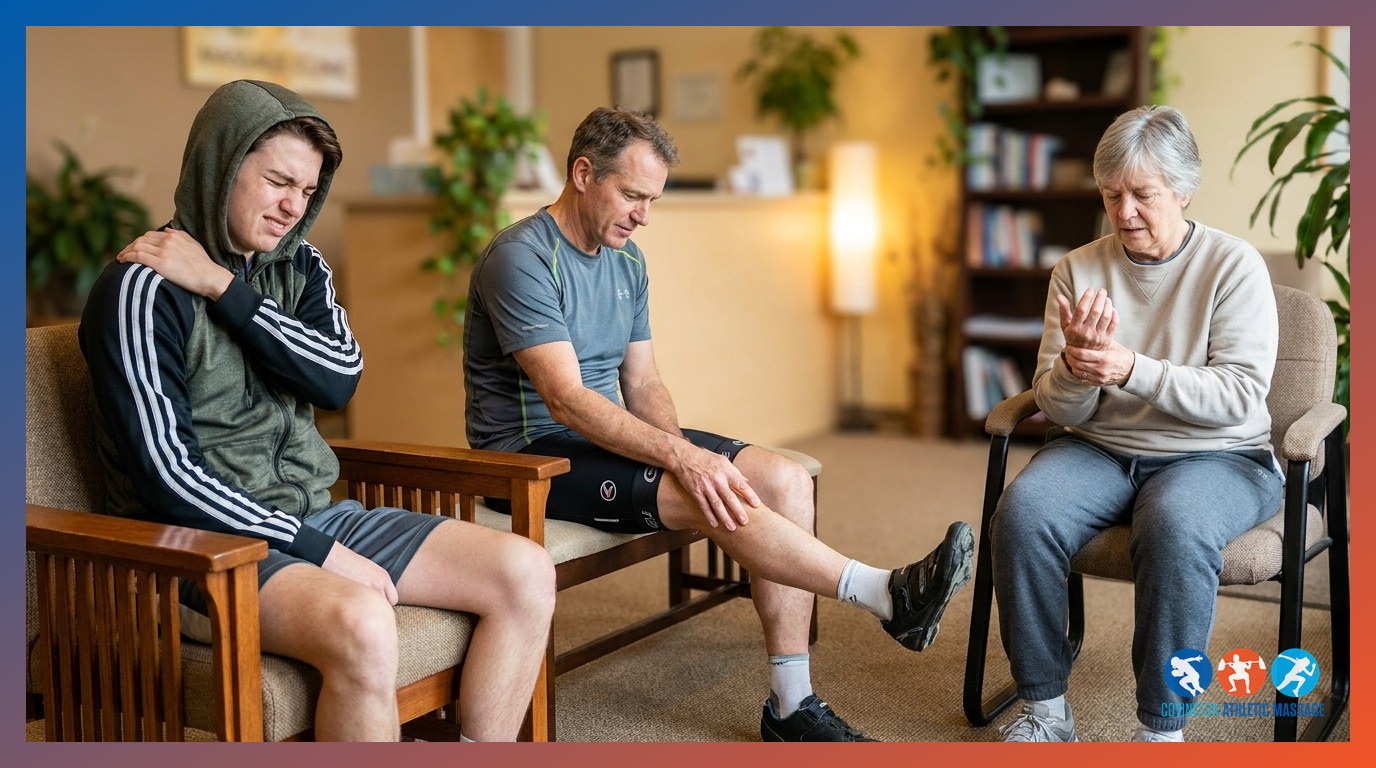
Athletes with a history of soft-tissue injury have a higher likelihood of residual scar tissue that creates chronic stiffness even after the original injury has healed. A strained hamstring, a torn rotator cuff, or a bout of tendinitis remodels tissue that rarely regains its original glide. Scar tissue explains the lingering stiffness. Athletes dealing with sport-specific injuries that created residual stiffness also benefit from the clinic’s Injury Care Massage offering, which addresses soft-tissue injury alongside the mobility deficits it leaves behind.
Active adults who train consistently still feel chronically tight in specific regions: hips, thoracic spine, shoulders, and hamstrings. A CrossFit member searching for tight shoulder mobility pain relief usually carries fascial restriction that stretching alone does not release. The same pattern drives runners toward hip mobility restoration massage when hip capsules stay guarded despite daily mobility work.
Athletes preparing for competition need full functional range of motion before peak performance demands return. According to a 2025 study published through the National Library of Medicine, bi-weekly deep tissue massage over eight weeks improved muscle strength and flexibility in 150 athletes aged 18 to 45, especially in the lumbar region, knee, and shoulder.
Recreational athletes over 35 face slower connective tissue recovery and faster adhesion accumulation than they did in younger training years. Many of these athletes notice that stiffness now lingers for days after sessions that once caused no soreness at all.
What does a mobility restoration massage session at Covington Athletic Massage involve?
A mobility restoration massage session at Covington Athletic Massage contains an assessment of movement restrictions, targeted deep tissue work, and myofascial release sequenced to restore functional range of motion. Every appointment follows that sequence, with pressure and focus matched to the individual athlete.
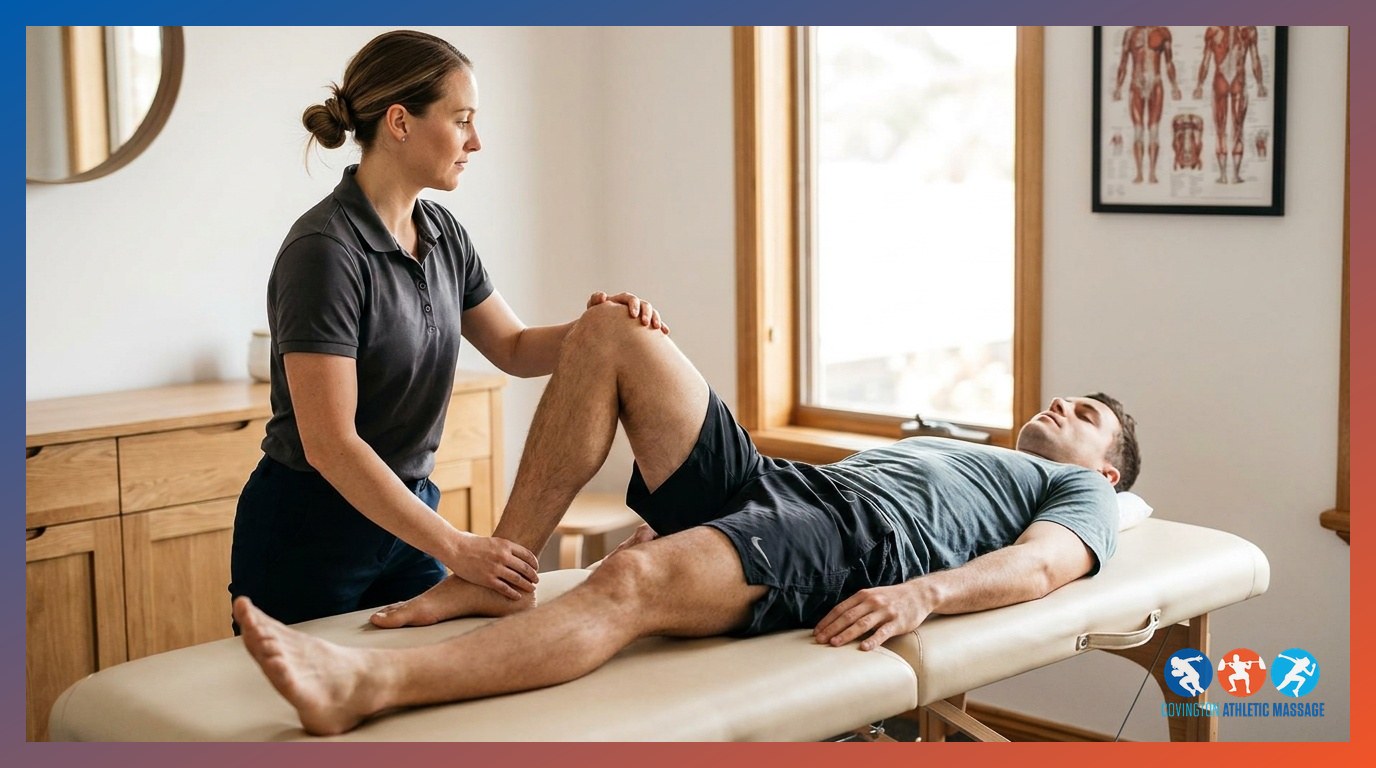
Your session begins with a movement and restriction assessment. You move the stiff joint through its available range while the therapist identifies the specific tissue layers and joint directions limiting your range of motion. The Covington mobility massage clinic builds each session on the assessment findings rather than a fixed routine, so the table work targets your actual limiters instead of general soreness.
The hands-on work follows a set order. The therapist starts with superficial tissue to prepare access, then progresses into deeper fascial and muscular layers as the tissue warms and allows. The therapist also adjusts pressure, pace, and direction in real time based on your feedback and how the tissue responds, instead of holding one uniform pressure across the whole body. That adaptability has evidence behind it: a 2026 study in Scientific Reports associated therapist-delivered manual massage with greater improvements in alleviating pain and enhancing functional mobility compared to foam rolling.
Athletes with chronic stiffness should expect mobility restoration to take more than one session. A first session breaks initial adhesions and opens the tissue, but the nervous system needs repeated input across multiple sessions to fully release protective tension patterns that have been present for months or years.
Booking is available in Covington, Georgia. The clinic encourages athletes with chronic stiffness to discuss a multi-session plan at the first appointment, since the initial assessment gives the therapist a baseline for sequencing future work. Athletes who prefer to manage stiffness as part of ongoing training maintenance rather than episodic treatment can use the clinic’s Athletic Massage Memberships, which provide structured recurring access.